Get our latest book recommendations, author news, competitions, offers, and other information right to your inbox.
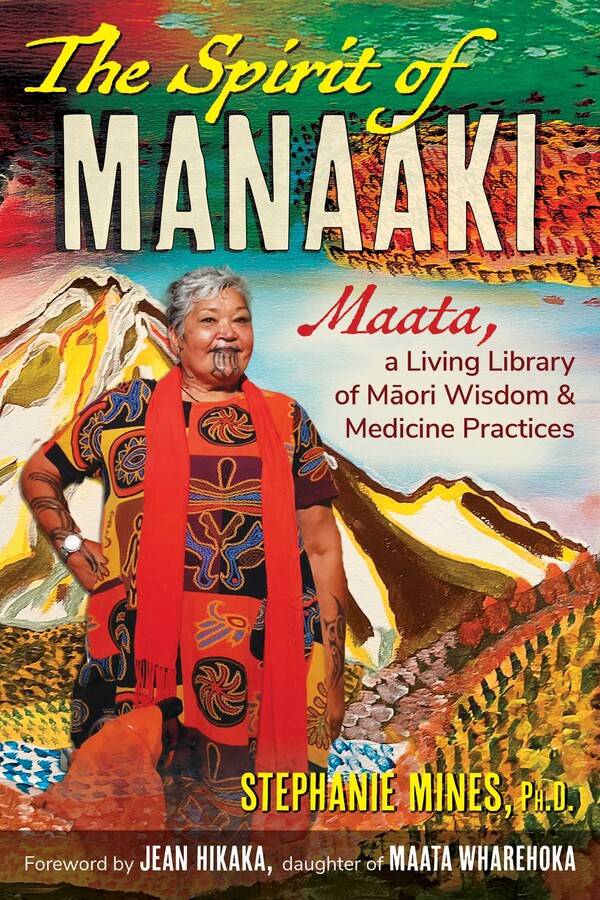
The Spirit of Manaaki
Maata, a Living Library of Maori Wisdom and Medicine Practices
Foreword by Jean Hikaka
Published by Park Street Press
Distributed by Simon & Schuster
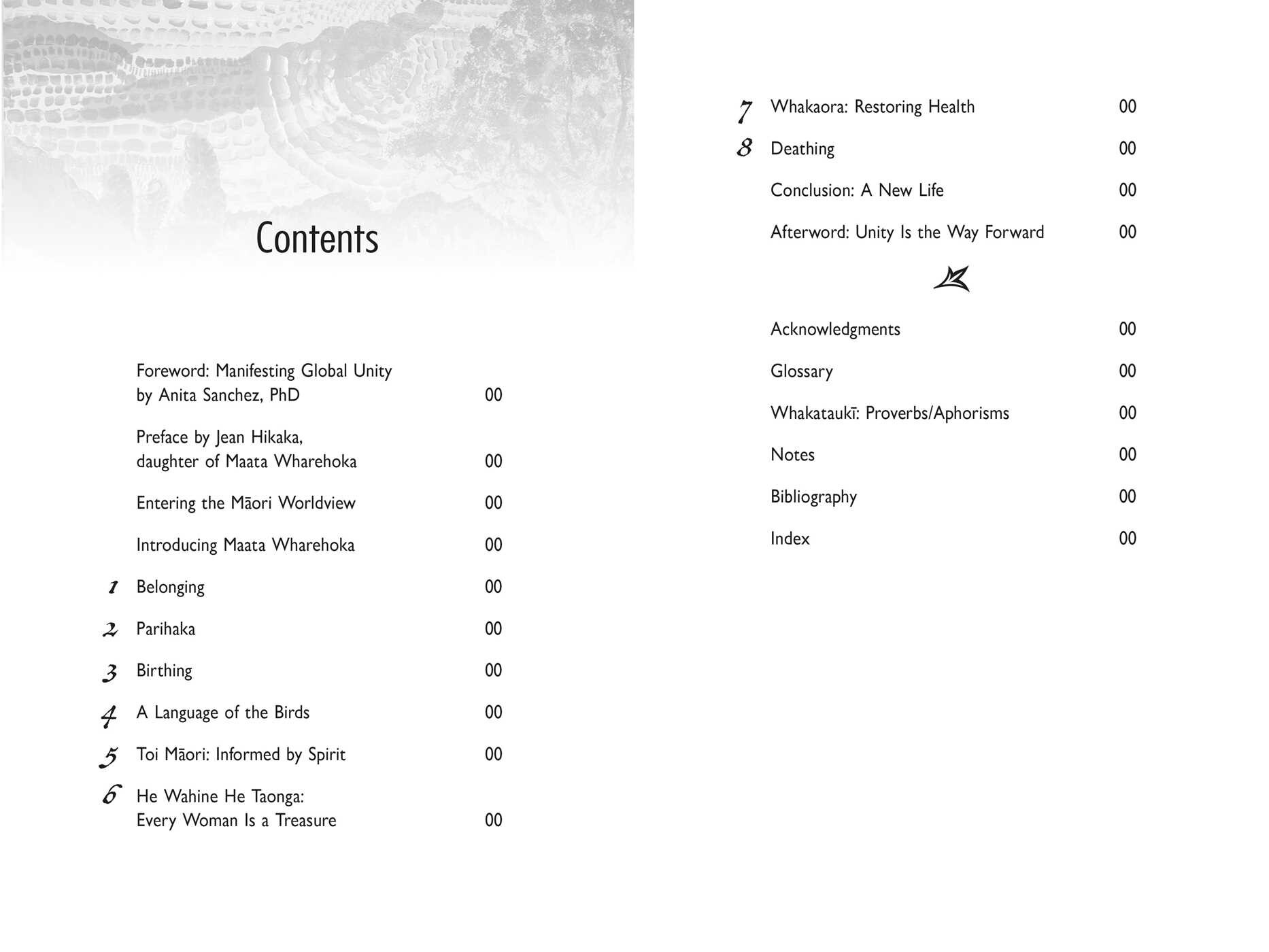
Table of Contents
About The Book
Maori elder Maata Wharehoka’s teachings on birth, death, climate, and healing
• Reveals how Maata integrated her own experiences of trauma and colonialism with traditional Māori wisdom to develop modern teachings
• Shares Māori practices around birth, death, and healing, and Maata’s ritual of Kahu Whakatere to embrace bereavement, transition, and loss
• Tells the story of Parihaka, the birthplace of nonviolent protest, and how its teachings speak to humanity today
Entering the Māori worldview is like stepping into a verdant landscape where humans and plants, animals, the land, rain, and mountains are united. This may sound like a step into a distant past, but it is the model of living that matriarch Maata Wharehoka has been sustaining her entire life in Aotearoa, New Zealand.
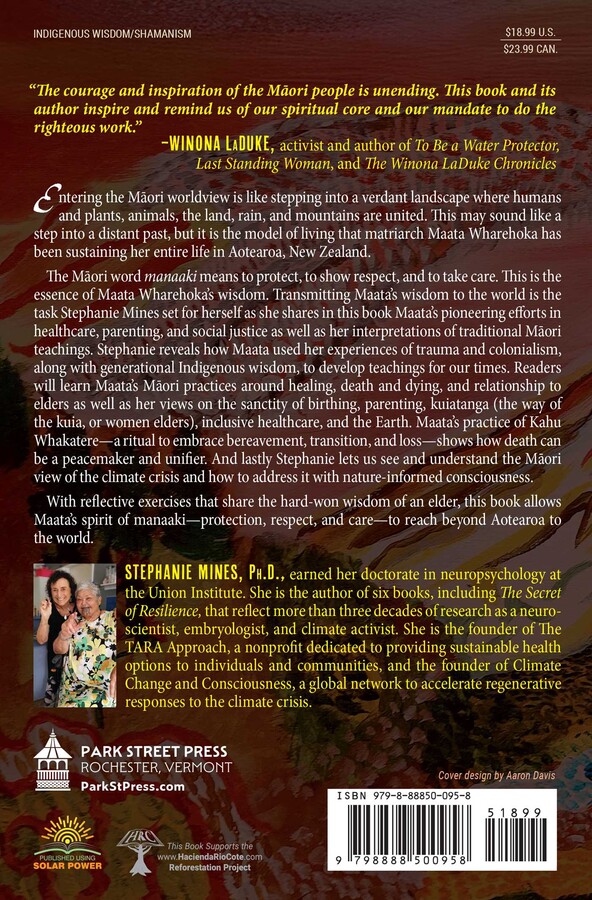
The Māori word manaaki means to protect, to show respect, and to take care. This is the essence of Maata Wharehoka’s wisdom. Transmitting Maata’s wisdom to the world is the task Stephanie Mines set for herself as she shares in this book Maata’s pioneering efforts in healthcare, parenting, and social justice as well as her interpretations of traditional Māori teachings. Stephanie reveals how Maata used her experiences of trauma and colonialism, along with generational Indigenous wisdom, to develop teachings for our times. Readers will learn Maata’s Māori practices around healing, death and dying, and relationship to elders as well as her views on the sanctity of birthing, parenting, kuiatanga (the way of the kuia, or women elders), inclusive healthcare, and the Earth. Maata’s practice of Kahu Whakatere—a ritual to embrace bereavement, transition, and loss—shows how death can be a peacemaker and unifier. And lastly Stephanie lets us see and understand the Māori view of the climate crisis and how to address it with nature-informed consciousness.
With reflective exercises that share the hard-won wisdom of an elder, this book allows Maata’s spirit of manaaki—protection, respect, and care—to reach beyond Aotearoa to the world.
• Reveals how Maata integrated her own experiences of trauma and colonialism with traditional Māori wisdom to develop modern teachings
• Shares Māori practices around birth, death, and healing, and Maata’s ritual of Kahu Whakatere to embrace bereavement, transition, and loss
• Tells the story of Parihaka, the birthplace of nonviolent protest, and how its teachings speak to humanity today
Entering the Māori worldview is like stepping into a verdant landscape where humans and plants, animals, the land, rain, and mountains are united. This may sound like a step into a distant past, but it is the model of living that matriarch Maata Wharehoka has been sustaining her entire life in Aotearoa, New Zealand.
The Māori word manaaki means to protect, to show respect, and to take care. This is the essence of Maata Wharehoka’s wisdom. Transmitting Maata’s wisdom to the world is the task Stephanie Mines set for herself as she shares in this book Maata’s pioneering efforts in healthcare, parenting, and social justice as well as her interpretations of traditional Māori teachings. Stephanie reveals how Maata used her experiences of trauma and colonialism, along with generational Indigenous wisdom, to develop teachings for our times. Readers will learn Maata’s Māori practices around healing, death and dying, and relationship to elders as well as her views on the sanctity of birthing, parenting, kuiatanga (the way of the kuia, or women elders), inclusive healthcare, and the Earth. Maata’s practice of Kahu Whakatere—a ritual to embrace bereavement, transition, and loss—shows how death can be a peacemaker and unifier. And lastly Stephanie lets us see and understand the Māori view of the climate crisis and how to address it with nature-informed consciousness.
With reflective exercises that share the hard-won wisdom of an elder, this book allows Maata’s spirit of manaaki—protection, respect, and care—to reach beyond Aotearoa to the world.
Excerpt
Entering the Maori Worldview
Indigenous people are our guides to an expansive, welcoming future that will allow our children to flourish. In order for Indigenous wisdom streams to be of service to us, we have to know how to hear them. To absorb traditional insight requires us to shift our worldviews and our ways of relating. This is both corrective and healing. This book helps you walk on a bridge toward unity with all peoples. Fundamental to creating the world we want our children to inherit is the inclusivity and unity that all traditional cultures espouse. As an exponent of this, Maata Wharehoka, the inspiration and central subject of this book, has a vocation of peacemaking. Maata speaks to us from the birthplace of nonviolence, the iconic Parihaka marae, or meeting grounds of the community. She is the living voice of Parihaka’s mission of peace.
In these pages we experience Maata’s catalyzing influence, love, strength, and creativity as she restores and regenerates Māori culture for her people and the world. She causes us to reflect on how we can ignite our own living experience of belonging and connection. It is only by feeling our kinship with the natural world and with each other that we have any hope of solving the metacrisis conditions that disconnection created. Maata shows us the way.
That way is mapped by the cultivation of cultural sensitivity. This is not just about being polite, or deferential. It is a shift in consciousness and a change of heart. When I first began interviewing Maata and her family and peers, I was an outsider looking in. I was listening and watching. Somewhere, sometime between then and now, I have entered the spaces that I was documenting from the outside. Though I am clearly not Māori by birth, it is as if I have gotten new lenses for my eyes, and I am beginning to see differently, as if from within the world rather than peering at it.
This is why I have included queries at the end of each chapter, inviting readers to take into their lives the places they inhabit and the relationships they have, considerations of cultural sovereignty, and why it is important to stand for values in this world we share. We evolve culture by how we regard and transmit it. If we allow our values to be torn asunder and trashed, then we are party to the disintegration of society and civilization. But if we stand for values that link us to a lineage of values, and evolve those values to adapt to current needs, never losing sight of integrity, then we can claim a legacy worth transmitting.
Maata Wharehoka is the model of holding true to values that come from deeply embodied lineage. She protects those values. The Te Reo Māori word manaaki applies here. Manaaki means to protect, to show respect, to take care. The time I have spent at Parihaka, where Maata lives, has infused me with manaaki. The transmission came not only from Maata herself but from the very air, the smells, the harakeke plants, and most of all, the whenua of Parihaka.
As you read this book, as you attune to who Maata is and what Parihaka emanates, and the leadership of Te Whiti o Rongomai and Tohu Kākahi, the originators of nonviolent protest, bear in your mind and heart the spirit of manaaki, the spirit of protection. I invite you to not only respect what is transmitted here but also to protect the values and intentions that I have done my best to relay and that have become part of me as a result of my experience and relationship with Maata Wharehoka and her family.
Entering the Māori worldview is like stepping into a verdant landscape in which humans and plants, animals, the land, the wind, the rain, the mountains, and the rivers, are united, blended, operating from the same intentionality, the same source. This may sound like it is a step into a distant, or even a fantasy, past, but it is actually a view of the future.
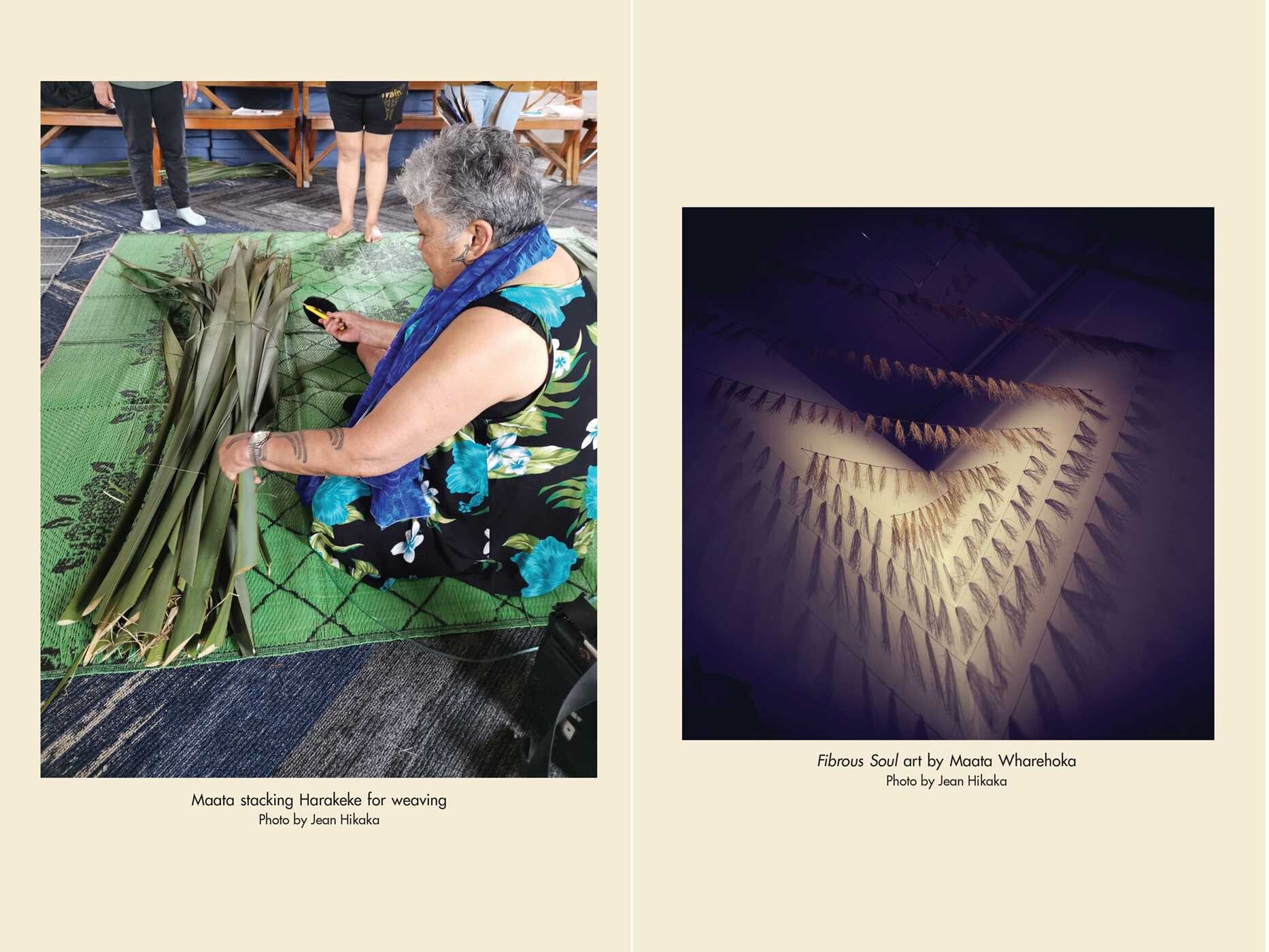
Te Ao Māori, the Māori worldview, is wisdom teaching for the world. It will be our salvation to enter the realm where life- and nature-informed consciousness rule every action, every perception, every choice. This is the model of connected living that Maata Wharehoka has been sustaining and regenerating. She is the stamina, the resilience, the adaptability, the inventiveness, and the pragmatic utility of the harakeke. Harakeke is medicinal. It is thick, yet pliable, and by human hands it is woven into clothing, baskets, mats, and art. It can be made so thin that it can be threaded through a needle.
In December 2023, as horrific tragedies continued to unfold after the events of October 7, Maata and I grieved together. Her sense of unity with the suffering of all people comes directly from the lineage of her people and of Te Whiti o Rongomai who predicted that “the nations of the world will be as one.” She and I, as mothers and grandmothers, keened for the massacred children, and dedicated ourselves to nonviolence and peace as we sat together in her whare at Parihaka.
I take full responsibility for the errors in this book and for my own ignorance in regard to any misrepresentations or confusion. It is an enormous privilege to be trusted to receive what the Wharehoka family and Maata’s friends and peers have shared with me.
It is my intention that this book serves the unity prophesized by Te Whiti o Rongomai. As he was accurate in all his other predictions, I hold on to the accuracy of this one.
Introducing Maata Wharehoka
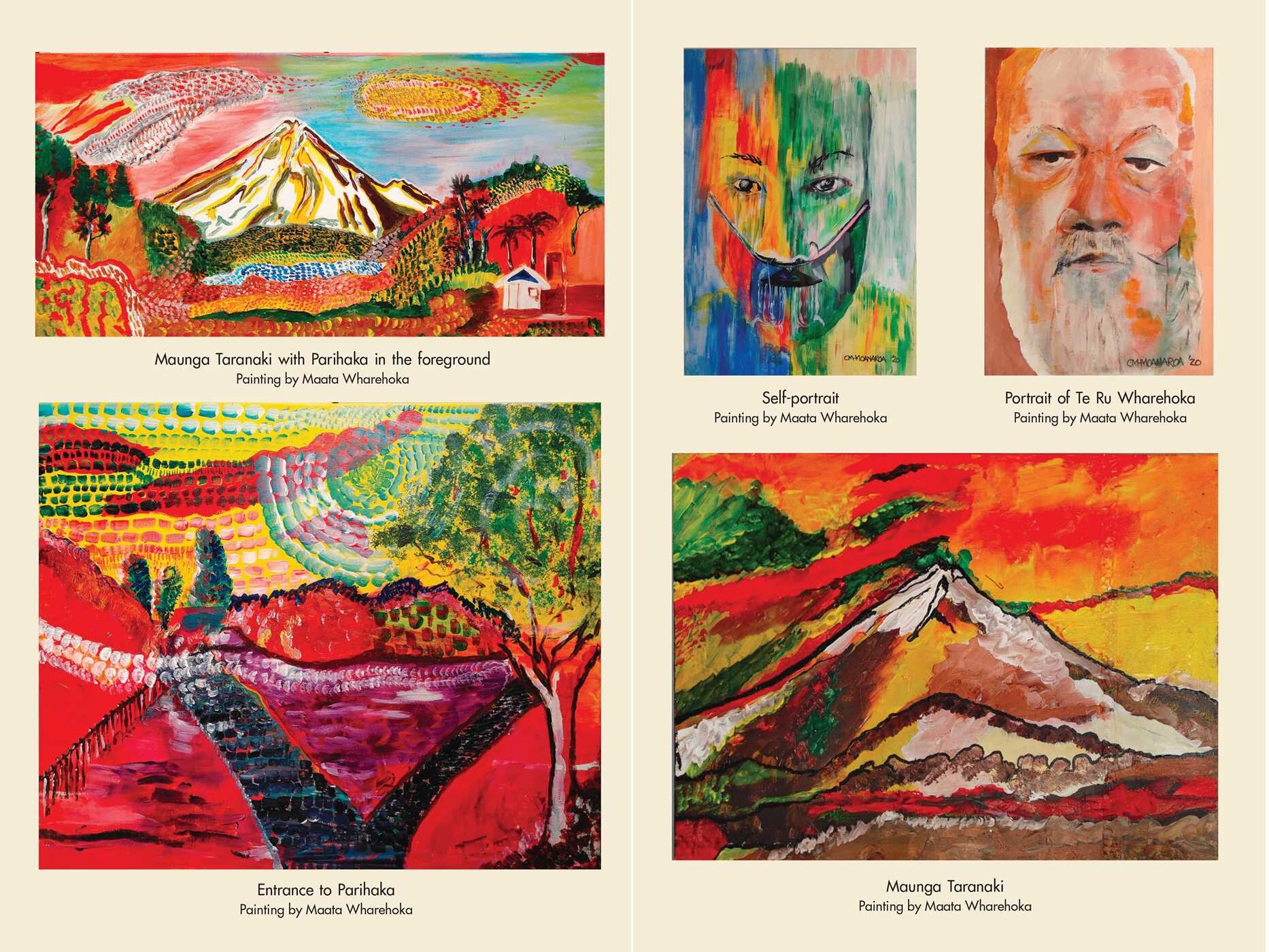
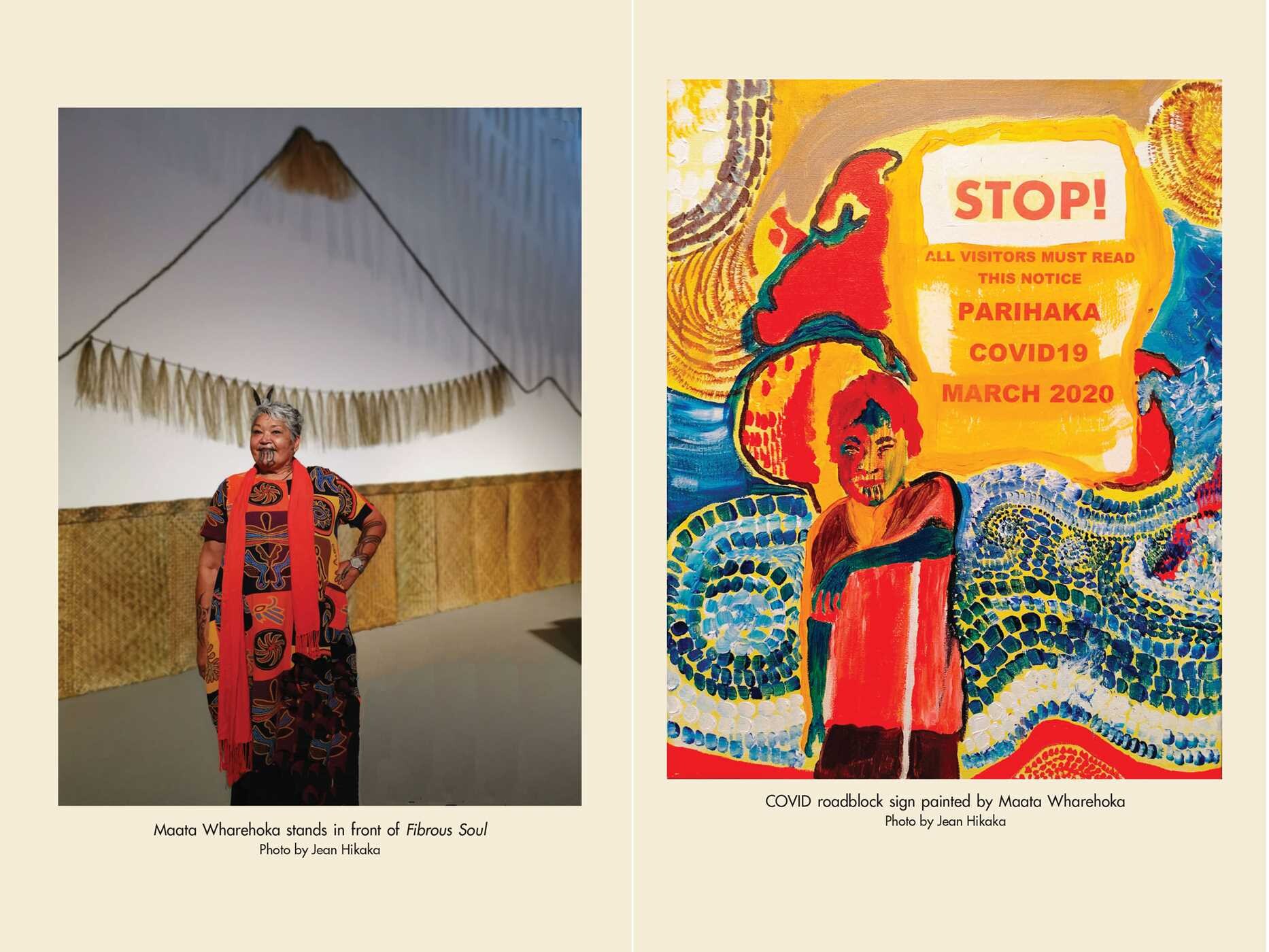
At the Parihaka marae in the shadow of Mount Taranaki, above the verdant sea cliffs of the North Island of Aotearoa (New Zealand), bordering the Tasman Sea, the thick fronds of the harakeke clap in the gusty wind like an audience applauding. The bright coral ngutukaka flowers, the pristine mānuka blossoms and kōkohurangi (tree daisies) dance around the harakeke, as if they were children, bowing to a queen mother.
At the top of a winding road, surrounded by pasture meadows and nearly forty-five kilometers from New Plymouth, the nearest Pākehā town and regional center is Maata’s home. Like the harakeke outside her door, she reigns there, and her mokopuna (grandchildren) along with her daughters and sons, are her mānuka blossoms. Maata has the fortitude, the sturdiness, and the intention to serve her people that is just like the hardy harakeke, also native to Aotearoa, and of which she is a master weaver.
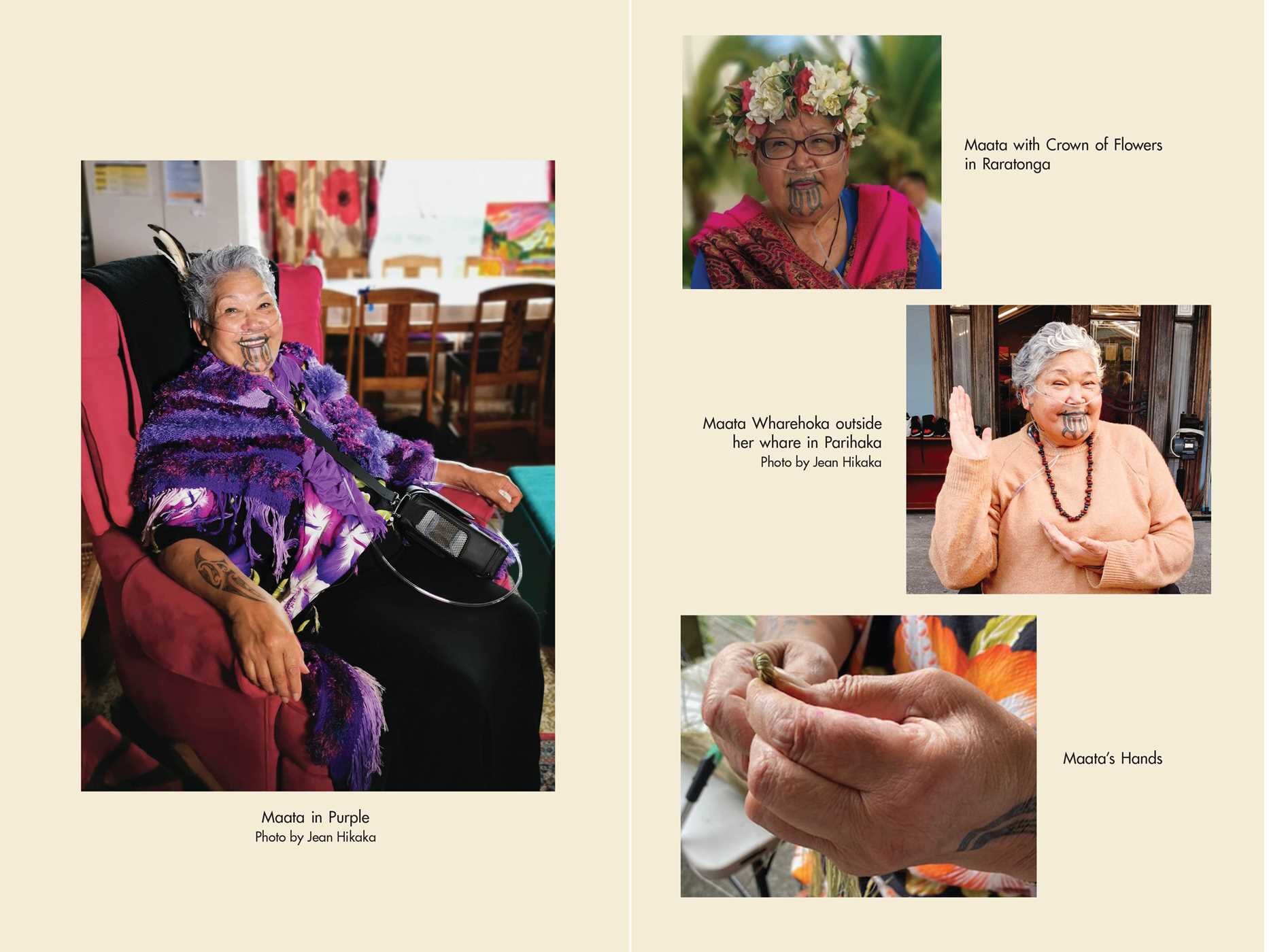
The rooms and walls of her whare (home) hold all the chapters in the compelling saga of Maata’s tireless devotion to her whānau (family), to Te Ao Māori (the Māori world view) and to Parihaka, about which you will hear a great deal in this book. When you enter the house, the first room is the spacious lounge, the wharenui, often filled with the play of children. The kitchen is the belly of the house, where food is shared generously with all who enter, including visitors, volunteers, interviewers like me, and community members.
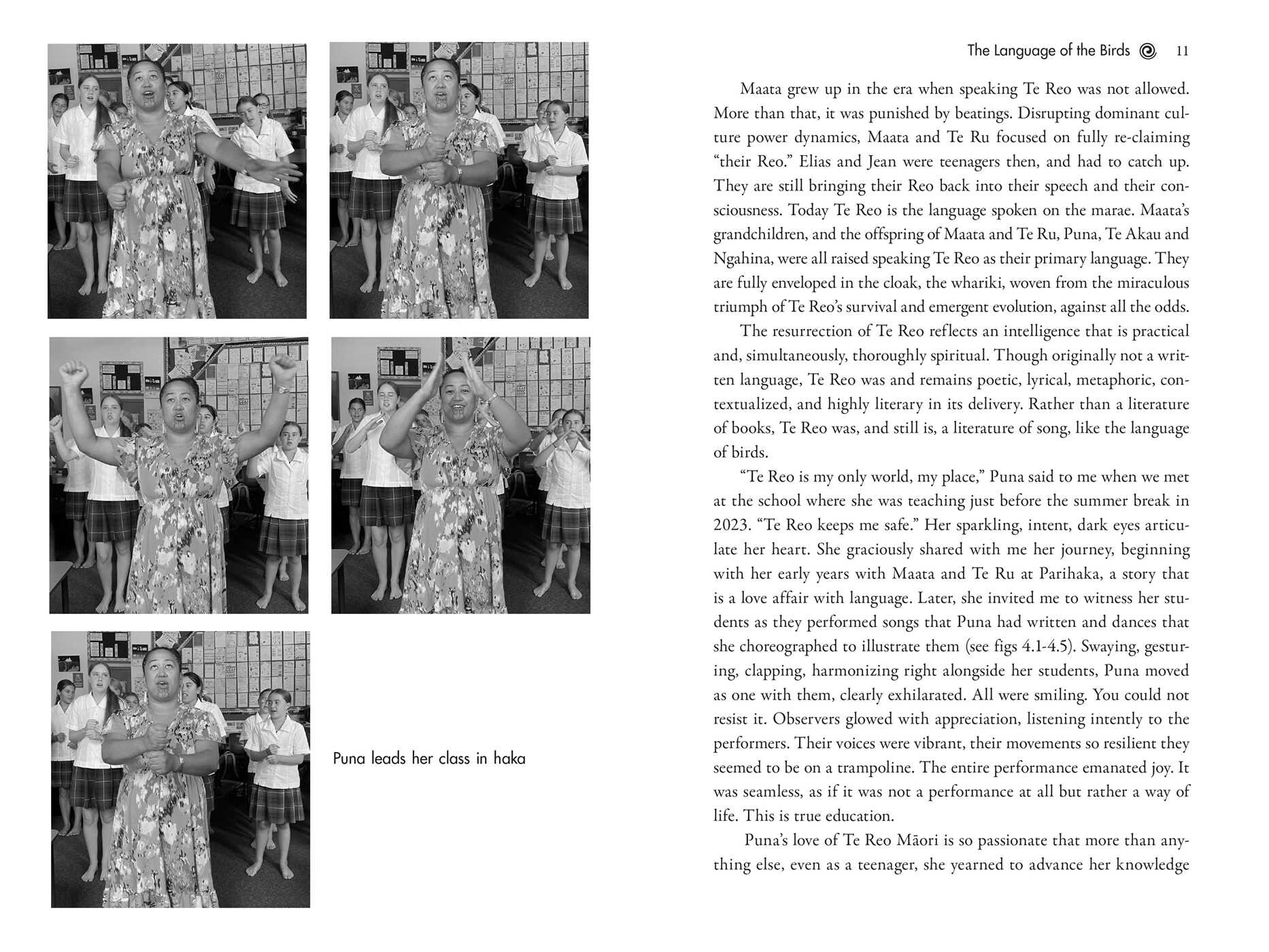
And then there is Maata’s room, the place where she rests, sleeps, reads, writes, creates art, and where Kahu Whakatere, the rite of passage for death and dying, was reborn. This is the room where Maata’s sister Millie and Maata’s husband, Te Ru, died, and through their deaths, contributed to the emergence of the cultural reclamation that is Kahu Whakatere. An entire chapter in this book is devoted to this because Kahu Whakatere encompasses every aspect of Maata’s legacy.
In the days of the third and final cycle of her life, Maata Wharehoka, despite illness and pain, is filled with the dynamic resilience of spirit, the life force or mana that was obvious to others in her childhood and her youth, indeed throughout her life, and that radiates from her even now.
Maata was not born in Parihaka, but she will die there, in that same room where her sister and husband died, wrapped in garments woven of harakeke. Her body will be at ease on a soft mat, still redolent with the earthy, fresh scent of the plants from which it was made, and woven by her family and her community. Her tenacious body, with all its accumulated struggles and burdens, its memories of mischief and defiance, of love and rebellion, will let go and be received into the land that is her source, her identity. She will be welcomed into the cool, protective shade of her mountain, Taranaki.
Indigenous people are our guides to an expansive, welcoming future that will allow our children to flourish. In order for Indigenous wisdom streams to be of service to us, we have to know how to hear them. To absorb traditional insight requires us to shift our worldviews and our ways of relating. This is both corrective and healing. This book helps you walk on a bridge toward unity with all peoples. Fundamental to creating the world we want our children to inherit is the inclusivity and unity that all traditional cultures espouse. As an exponent of this, Maata Wharehoka, the inspiration and central subject of this book, has a vocation of peacemaking. Maata speaks to us from the birthplace of nonviolence, the iconic Parihaka marae, or meeting grounds of the community. She is the living voice of Parihaka’s mission of peace.
In these pages we experience Maata’s catalyzing influence, love, strength, and creativity as she restores and regenerates Māori culture for her people and the world. She causes us to reflect on how we can ignite our own living experience of belonging and connection. It is only by feeling our kinship with the natural world and with each other that we have any hope of solving the metacrisis conditions that disconnection created. Maata shows us the way.
That way is mapped by the cultivation of cultural sensitivity. This is not just about being polite, or deferential. It is a shift in consciousness and a change of heart. When I first began interviewing Maata and her family and peers, I was an outsider looking in. I was listening and watching. Somewhere, sometime between then and now, I have entered the spaces that I was documenting from the outside. Though I am clearly not Māori by birth, it is as if I have gotten new lenses for my eyes, and I am beginning to see differently, as if from within the world rather than peering at it.
This is why I have included queries at the end of each chapter, inviting readers to take into their lives the places they inhabit and the relationships they have, considerations of cultural sovereignty, and why it is important to stand for values in this world we share. We evolve culture by how we regard and transmit it. If we allow our values to be torn asunder and trashed, then we are party to the disintegration of society and civilization. But if we stand for values that link us to a lineage of values, and evolve those values to adapt to current needs, never losing sight of integrity, then we can claim a legacy worth transmitting.
Maata Wharehoka is the model of holding true to values that come from deeply embodied lineage. She protects those values. The Te Reo Māori word manaaki applies here. Manaaki means to protect, to show respect, to take care. The time I have spent at Parihaka, where Maata lives, has infused me with manaaki. The transmission came not only from Maata herself but from the very air, the smells, the harakeke plants, and most of all, the whenua of Parihaka.
As you read this book, as you attune to who Maata is and what Parihaka emanates, and the leadership of Te Whiti o Rongomai and Tohu Kākahi, the originators of nonviolent protest, bear in your mind and heart the spirit of manaaki, the spirit of protection. I invite you to not only respect what is transmitted here but also to protect the values and intentions that I have done my best to relay and that have become part of me as a result of my experience and relationship with Maata Wharehoka and her family.
Entering the Māori worldview is like stepping into a verdant landscape in which humans and plants, animals, the land, the wind, the rain, the mountains, and the rivers, are united, blended, operating from the same intentionality, the same source. This may sound like it is a step into a distant, or even a fantasy, past, but it is actually a view of the future.
Te Ao Māori, the Māori worldview, is wisdom teaching for the world. It will be our salvation to enter the realm where life- and nature-informed consciousness rule every action, every perception, every choice. This is the model of connected living that Maata Wharehoka has been sustaining and regenerating. She is the stamina, the resilience, the adaptability, the inventiveness, and the pragmatic utility of the harakeke. Harakeke is medicinal. It is thick, yet pliable, and by human hands it is woven into clothing, baskets, mats, and art. It can be made so thin that it can be threaded through a needle.
In December 2023, as horrific tragedies continued to unfold after the events of October 7, Maata and I grieved together. Her sense of unity with the suffering of all people comes directly from the lineage of her people and of Te Whiti o Rongomai who predicted that “the nations of the world will be as one.” She and I, as mothers and grandmothers, keened for the massacred children, and dedicated ourselves to nonviolence and peace as we sat together in her whare at Parihaka.
I take full responsibility for the errors in this book and for my own ignorance in regard to any misrepresentations or confusion. It is an enormous privilege to be trusted to receive what the Wharehoka family and Maata’s friends and peers have shared with me.
It is my intention that this book serves the unity prophesized by Te Whiti o Rongomai. As he was accurate in all his other predictions, I hold on to the accuracy of this one.
Introducing Maata Wharehoka
At the Parihaka marae in the shadow of Mount Taranaki, above the verdant sea cliffs of the North Island of Aotearoa (New Zealand), bordering the Tasman Sea, the thick fronds of the harakeke clap in the gusty wind like an audience applauding. The bright coral ngutukaka flowers, the pristine mānuka blossoms and kōkohurangi (tree daisies) dance around the harakeke, as if they were children, bowing to a queen mother.
At the top of a winding road, surrounded by pasture meadows and nearly forty-five kilometers from New Plymouth, the nearest Pākehā town and regional center is Maata’s home. Like the harakeke outside her door, she reigns there, and her mokopuna (grandchildren) along with her daughters and sons, are her mānuka blossoms. Maata has the fortitude, the sturdiness, and the intention to serve her people that is just like the hardy harakeke, also native to Aotearoa, and of which she is a master weaver.
The rooms and walls of her whare (home) hold all the chapters in the compelling saga of Maata’s tireless devotion to her whānau (family), to Te Ao Māori (the Māori world view) and to Parihaka, about which you will hear a great deal in this book. When you enter the house, the first room is the spacious lounge, the wharenui, often filled with the play of children. The kitchen is the belly of the house, where food is shared generously with all who enter, including visitors, volunteers, interviewers like me, and community members.
And then there is Maata’s room, the place where she rests, sleeps, reads, writes, creates art, and where Kahu Whakatere, the rite of passage for death and dying, was reborn. This is the room where Maata’s sister Millie and Maata’s husband, Te Ru, died, and through their deaths, contributed to the emergence of the cultural reclamation that is Kahu Whakatere. An entire chapter in this book is devoted to this because Kahu Whakatere encompasses every aspect of Maata’s legacy.
In the days of the third and final cycle of her life, Maata Wharehoka, despite illness and pain, is filled with the dynamic resilience of spirit, the life force or mana that was obvious to others in her childhood and her youth, indeed throughout her life, and that radiates from her even now.
Maata was not born in Parihaka, but she will die there, in that same room where her sister and husband died, wrapped in garments woven of harakeke. Her body will be at ease on a soft mat, still redolent with the earthy, fresh scent of the plants from which it was made, and woven by her family and her community. Her tenacious body, with all its accumulated struggles and burdens, its memories of mischief and defiance, of love and rebellion, will let go and be received into the land that is her source, her identity. She will be welcomed into the cool, protective shade of her mountain, Taranaki.
Product Details
- Publisher: Park Street Press (January 29, 2026)
- Length: 168 pages
- ISBN13: 9798888500958
Browse Related Books
Raves and Reviews
“The courage and inspiration of the Maori people is unending. This book and its author inspire and remind us of our spiritual core and our mandate to do the righteous work.”
– Winona LaDuke, activist and author of To Be a Water Protector, Last Standing Woman, and The Winona L
“Born homesick, I am the child of many cultures, displaced and yearning to be rooted in my own ancestral homeland. . . . I felt the hands of Maata were weaving along with my heart and hands a story of redemption, of forgiving, for all the generations of my people who lost their authentic customs and way of life. . . . Thank you, Maata; thank you, Stephanie; thank you, all our ancestors; and all our future generations to come—our love is the revolution of peace on Earth.”
– Ibu Robin Lim, founder of Bumi Sehat and 2011 CNN Hero of the Year
“The Spirit of Manaaki is a rare and welcome creation of integrative storytelling. Stephanie Mines skillfully, humbly, and lovingly bridges our shattered, dominant worldview with the relationally aware and intact Indigenous worldview of the Maori, while centering Maata’s guidance for cultivating our own capacities for stewarding life, finding belonging, and forgiving the unforgivable as a path to love of self and others. This journey into the Maori world may sound like ‘a step into a distant, or even a fantasy, past, but it is actually a view of the future.’”
– Lisa Reagan, founder of Kindred World and editor of Kindred Magazine
“The Spirit of Manaaki is a profound revelation, an awakening that nurtures hope for real, positive change in your life, the world, and our planet.”
– Antonella Sansone, Ph.D., creator of the Prenatal Mindfulness Relationship-Based program
“This book is a reverent offering to Maata Wharehoka and the living legacy of Parihaka—a place where ancestral memory, nonviolent resistance, and cultural sovereignty are tended through daily practice. Through story, ritual, and the weaving of feminine and landbased wisdom, it reveals a vision of leadership rooted not in control, but in sacred reciprocity and collective care.”
– Allie Davis, Ph.D., maternal ecotherapist and creator of the Mother Tree Method
“If we are to survive these challenging times, we must read The Spirit of Manaaki and imbibe the worldview of the elder wisdom of Maata Wharehoka that we desperately need.”
– Cherionna Menzam-Sills, Ph.D., author of The Prenatal Shadow
“Stephanie Mines conveys the story of Maata Wharehoka with reverence and responsibility, offering a bridge between generations, cultures, and worlds in service to a future rooted in ancestral truth. This book is a sacred act of remembrance that transcends the page.”
– Kristy King, M.D., Regenerative and Environmental Medicine, and women’s health advocate
“The Spirit of Manaaki contains timeless Maori wisdom that reminds us of universal truths on a profound cellular level. These truths provide the guidance we need to mend what has been broken and move forward together as one human family, creating peace on Earth.”
– Sierra Sugrue, N.D.
“The Spirit of Manaaki is a lyrical catalogue of the impact of a Maori woman rooted in self-determination and dedication to her people. As a Pakeha (settler) woman in Aotearoa (New Zealand) who aspires to become a regenerative health leader, I find the stories and wisdom in this book to be invaluable teachings on my path. I am thrilled to have this book for myself, and appreciate that, through it, Maata’s legacy will continue to positively affect the world, reaching everwidening circles for the benefit of all life.”
– Chloe Waretini, trauma therapist, Aotearoa
“The Spirit of Manaaki is a moving tribute by author Stephanie Mines to Parihaka leader Maata Wharehoka, who places Maata among the great wahine Maori of our time.”
– Donna Kerridge, Rongoa Maori Practitioner
Resources and Downloads
High Resolution Images
-
Book Cover Image (jpg): The Spirit of Manaaki
Trade Paperback 9798888500958