Get our latest book recommendations, author news, competitions, offers, and other information right to your inbox.
The Original Petit Etteilla
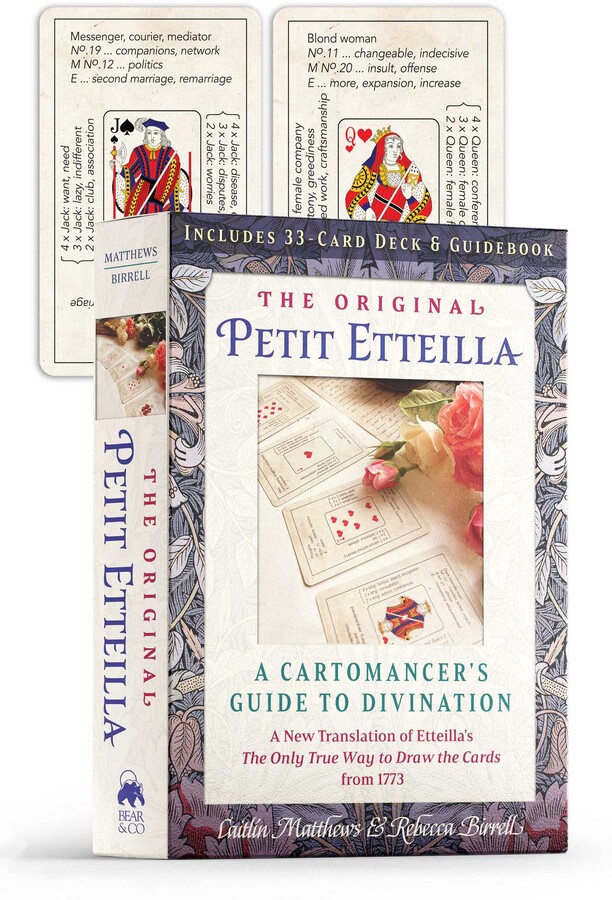
A Cartomancer's Guide to Divination
By Caitlín Matthews and Rebecca Birrell
Published by Destiny Books
Distributed by Simon & Schuster
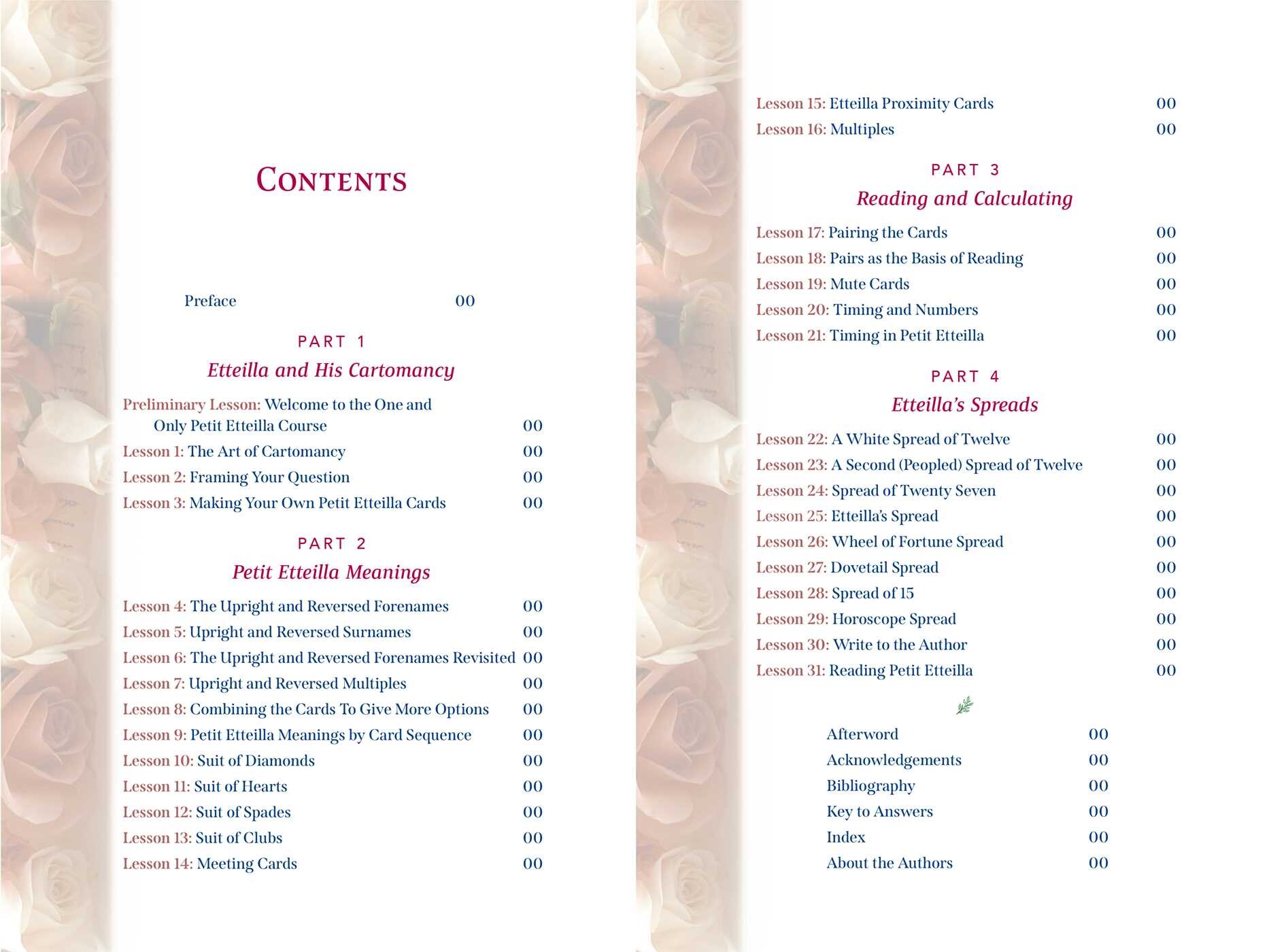
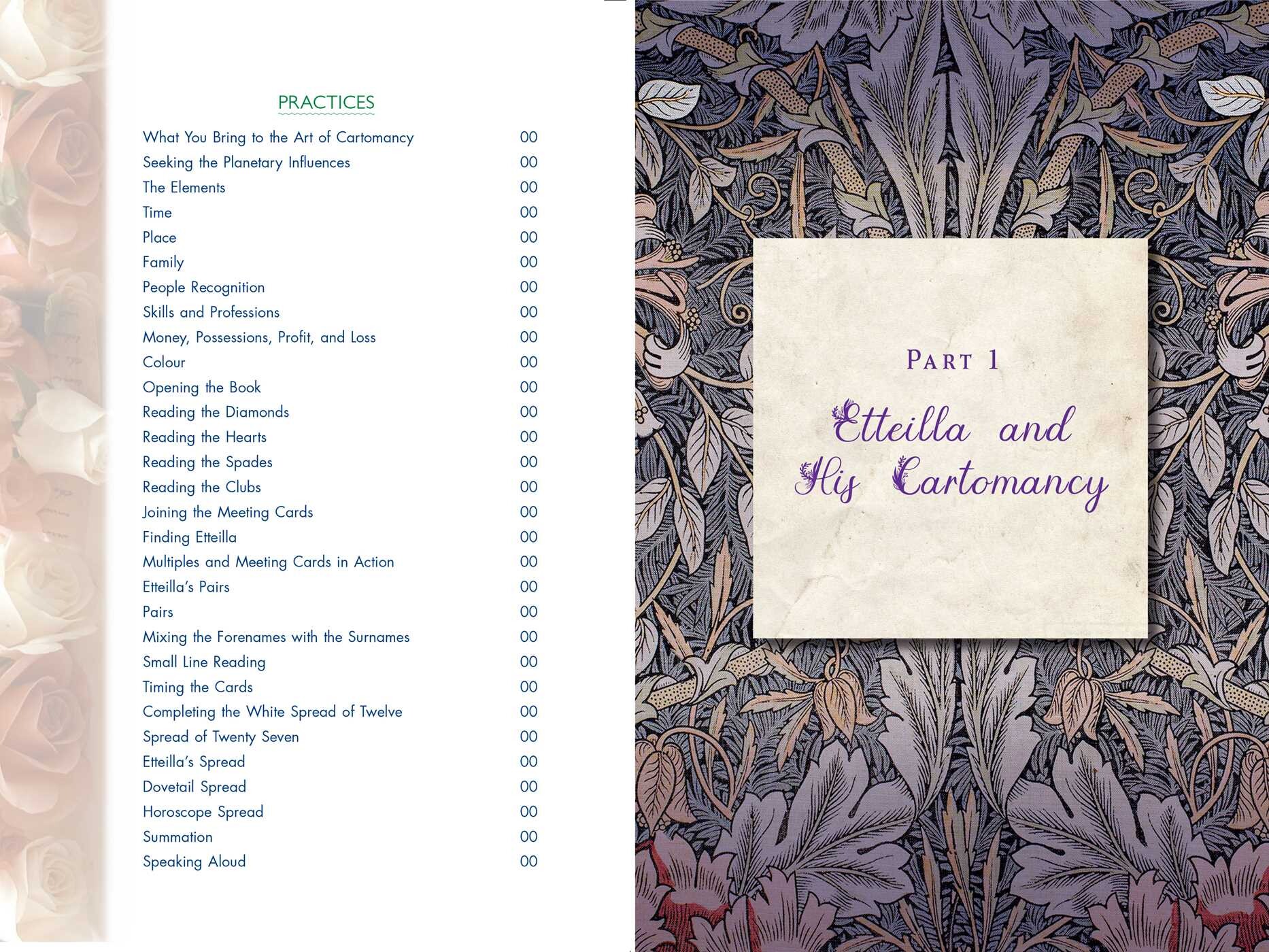
Table of Contents
About The Book
Learn foundational methods of divination from the Father of Cartomancy
• Provides the first English edition of Etteilla’s seminal text, an Etteilla deck, and a tutorial on how to make your own deck
• Offers eight main spreads along with variations, devised by Etteilla, and accompanying commentary and case studies
• Shares how Etteilla’s 1770 method set the standard for most European cartomantic divination, influencing the development of both cartomancy and tarot
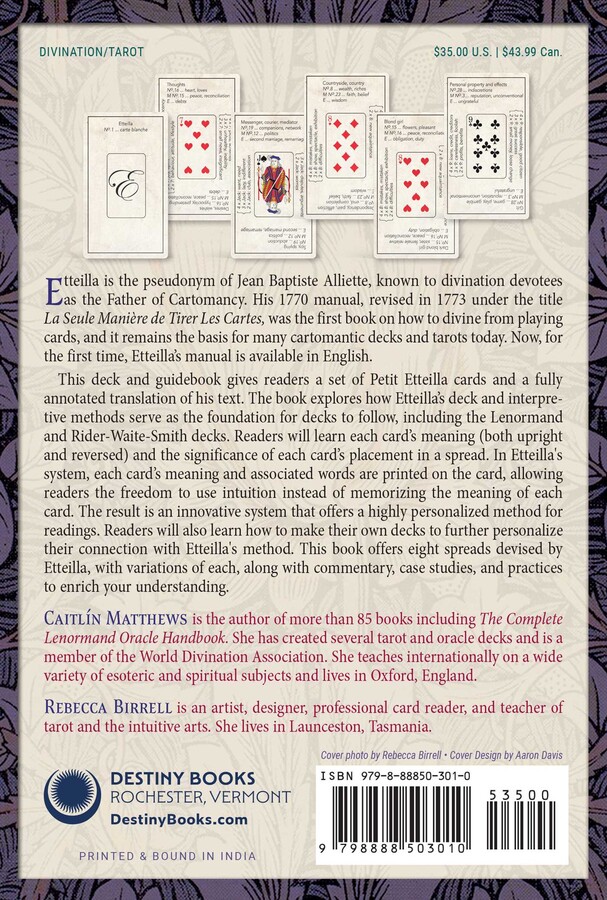
Etteilla is the pseudonym of Jean Baptiste Alliette, known to divination devotees as the Father of Cartomancy. His 1770 manual, revised in 1773 under the title La Seule Manière de Tirer Les Cartes, was the first book on how to divine from playing cards, and it remains the basis for many cartomantic decks and tarots today. Now, for the first time, Etteilla’s manual is available in English.
This deck and guidebook gives readers a set of Petit Etteilla cards and a fully annotated translation of his text. The book explores how Etteilla’s deck and interpretive methods serve as the foundation for decks to follow, including the Lenormand and Rider-Waite-Smith decks. Readers will learn each card’s meaning (both upright and reversed) and the significance of each card’s placement in a spread. In Etteilla's system, each card’s meaning and associated words are printed on the card, allowing readers the freedom to use intuition instead of memorizing the meaning of each card. The result is an innovative system that offers a highly personalized method for readings. Readers will also learn how to make their own decks to further personalize their connection with Etteilla's method. This book offers eight spreads devised by Etteilla, with variations of each, along with commentary, case studies, and practices to enrich your understanding.
• Provides the first English edition of Etteilla’s seminal text, an Etteilla deck, and a tutorial on how to make your own deck
• Offers eight main spreads along with variations, devised by Etteilla, and accompanying commentary and case studies
• Shares how Etteilla’s 1770 method set the standard for most European cartomantic divination, influencing the development of both cartomancy and tarot
Etteilla is the pseudonym of Jean Baptiste Alliette, known to divination devotees as the Father of Cartomancy. His 1770 manual, revised in 1773 under the title La Seule Manière de Tirer Les Cartes, was the first book on how to divine from playing cards, and it remains the basis for many cartomantic decks and tarots today. Now, for the first time, Etteilla’s manual is available in English.
This deck and guidebook gives readers a set of Petit Etteilla cards and a fully annotated translation of his text. The book explores how Etteilla’s deck and interpretive methods serve as the foundation for decks to follow, including the Lenormand and Rider-Waite-Smith decks. Readers will learn each card’s meaning (both upright and reversed) and the significance of each card’s placement in a spread. In Etteilla's system, each card’s meaning and associated words are printed on the card, allowing readers the freedom to use intuition instead of memorizing the meaning of each card. The result is an innovative system that offers a highly personalized method for readings. Readers will also learn how to make their own decks to further personalize their connection with Etteilla's method. This book offers eight spreads devised by Etteilla, with variations of each, along with commentary, case studies, and practices to enrich your understanding.
Excerpt
Preliminary Lesson
Welcome to The Original Petit Etteilla
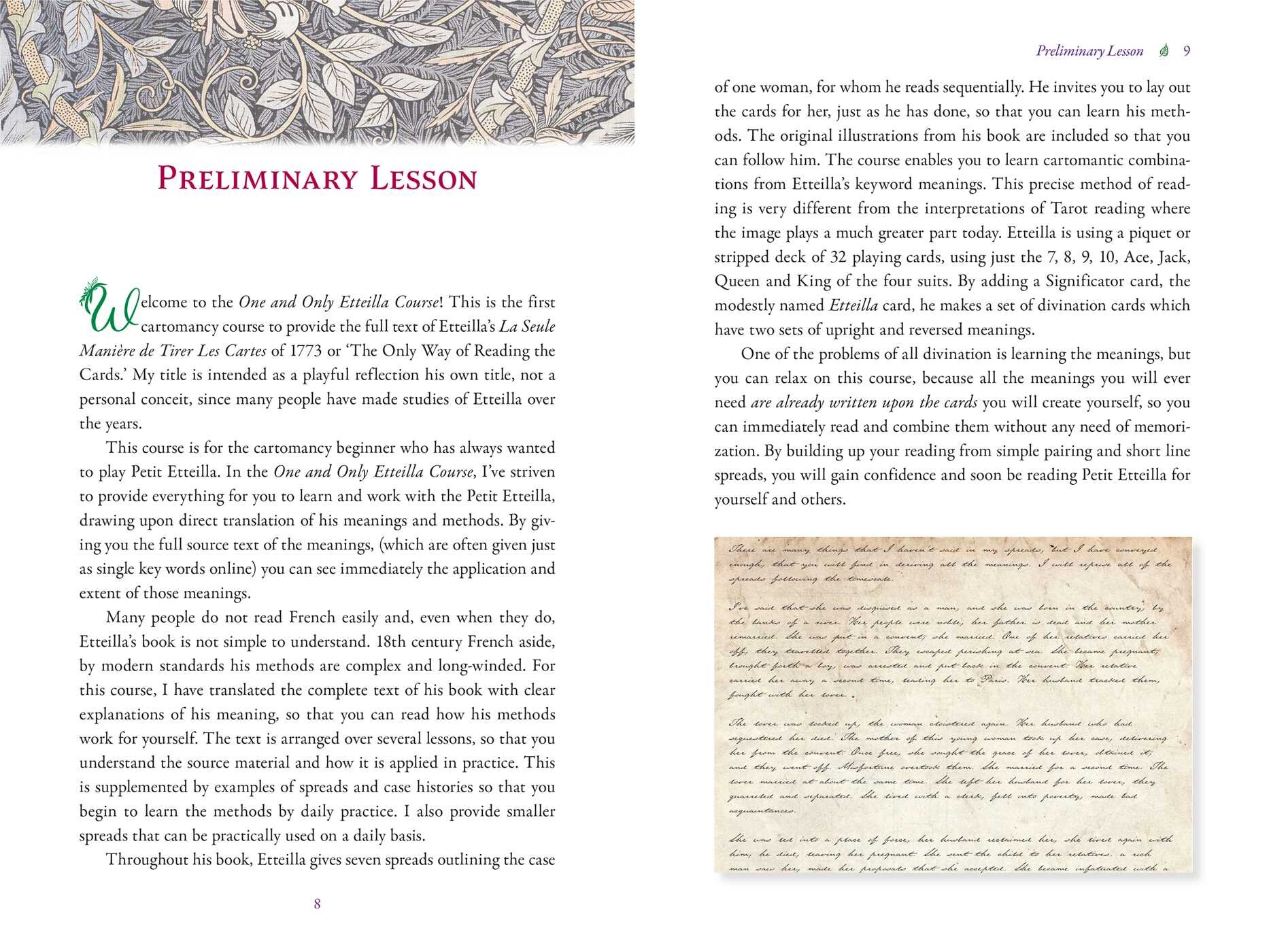
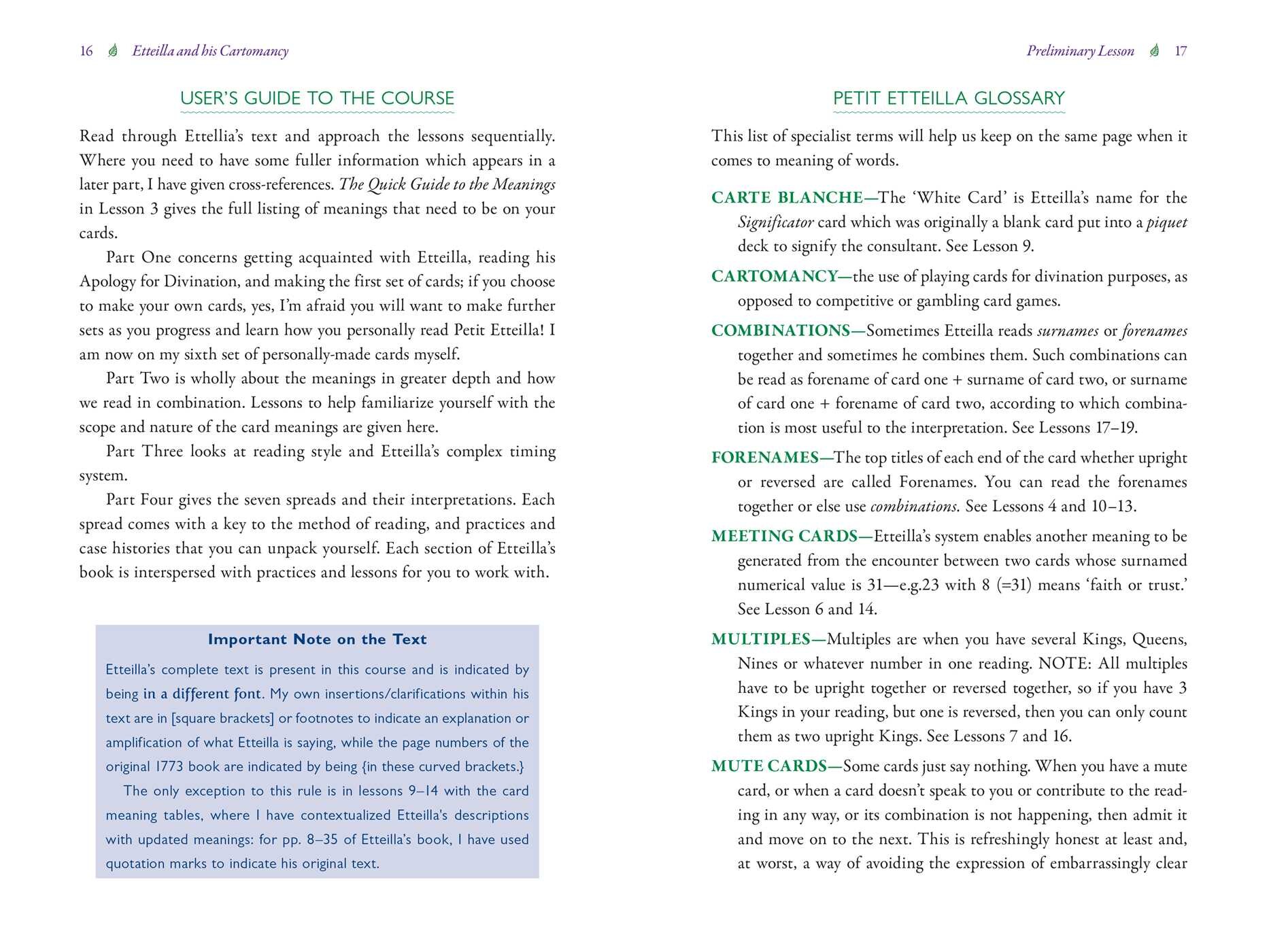
Welcome to The Original Petit Etteilla. This is the first cartomancy course to provide the full translated text of Etteilla’s La Seule Manière de Tirer les Cartes, or The Only True Way to Draw the Cards, first published in 1773.
This course is for the cartomancy beginner who has always wanted to play Petit Etteilla. In The Original Petit Etteilla, I have striven to provide everything you will need to learn and work with the Petit Etteilla, drawing upon direct translation of Etteilla’s meanings and methods.
Even for a native French speaker, Etteilla’s book is not simple to understand. Eighteenth century French aside, by modern standards his methods are complex and long-winded. For this course I have both translated the complete text of his book and have provided clear explanations of his meanings, which are often given as just a single keyword online. The text is introduced over several lessons, so that you may come to understand the material’s application as well as its context. This is supplemented by examples of spreads and case histories to support you in learning the methods through daily practice.
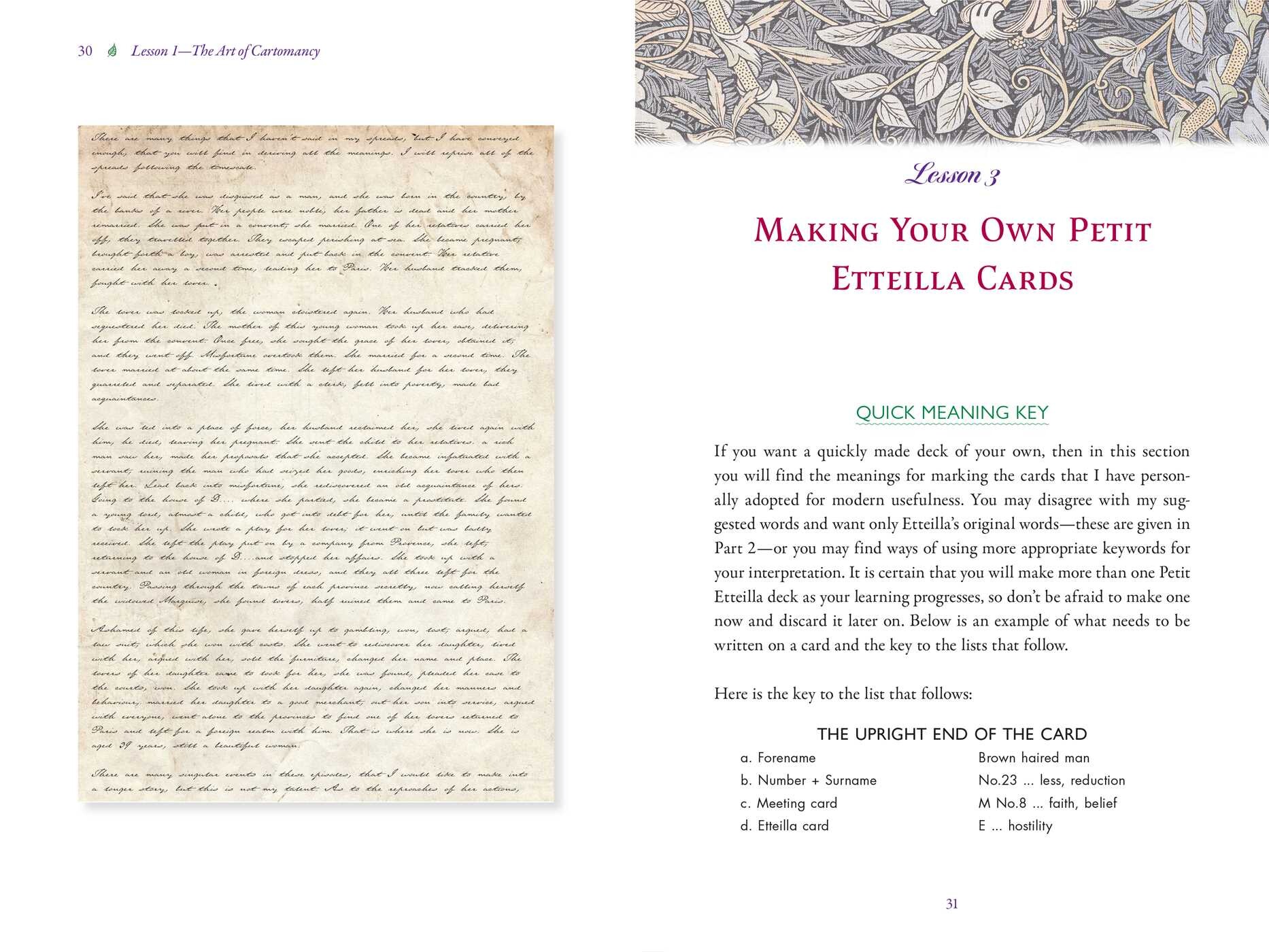
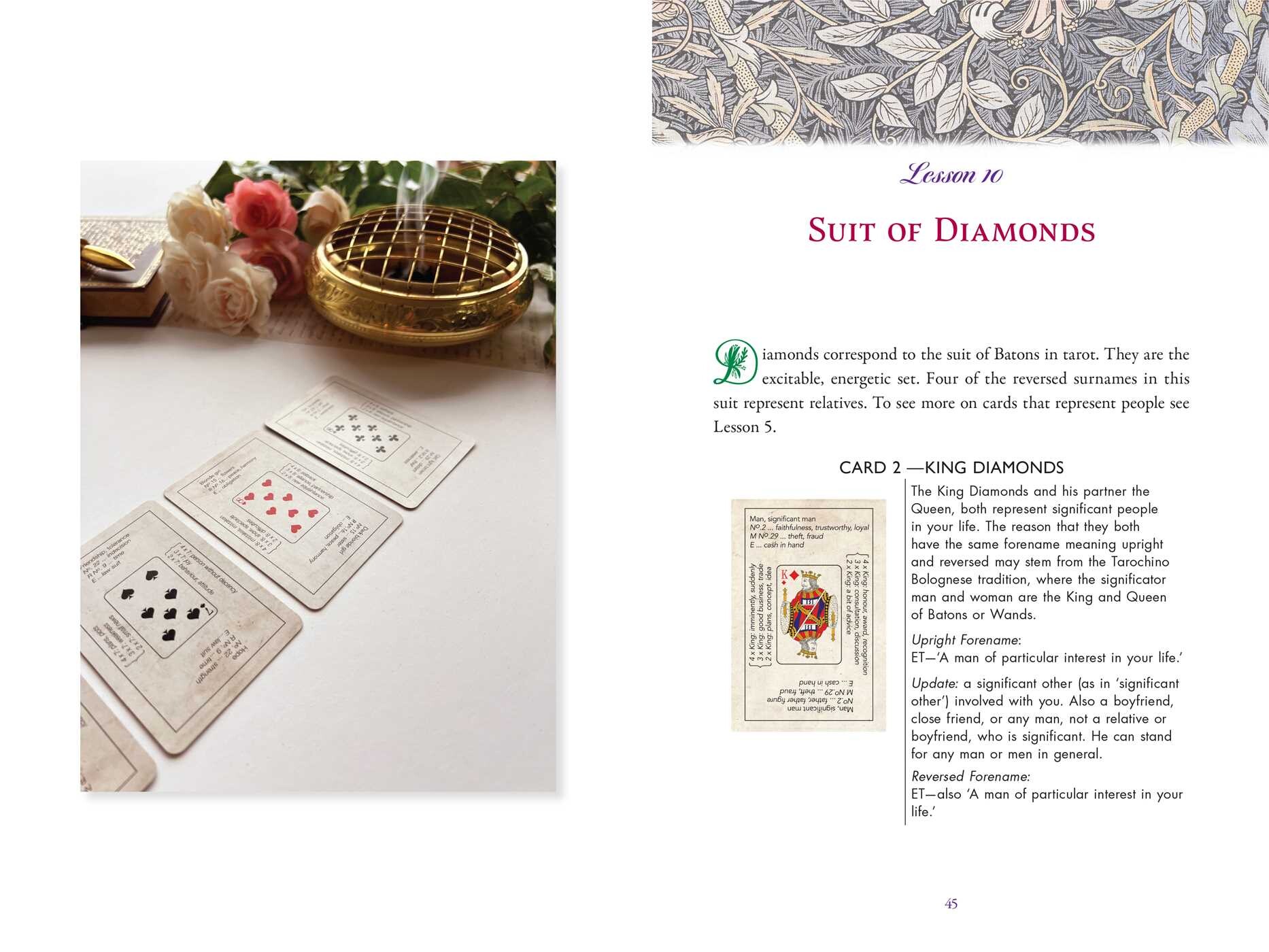
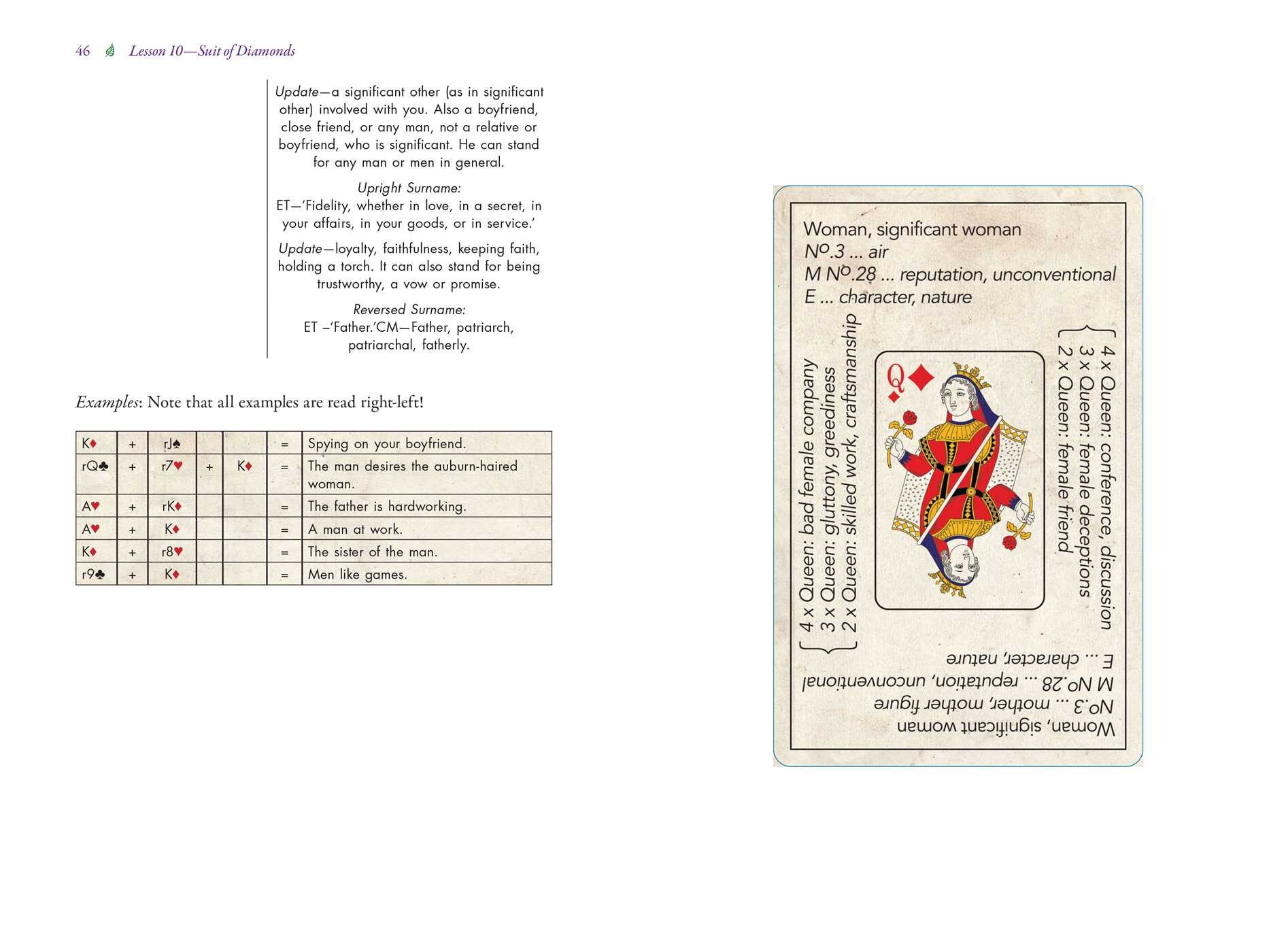
Throughout his book, Etteilla demonstrates seven spreads, sequentially outlining the case of one woman for whom he reads. He invites you to lay out the cards for her, just as he has done, in order to learn his method. The original illustrations from his book are included so that you may follow along. This precise method of reading is very different from modern tarot reading, where the interpretation of a card’s image plays a much greater role. Etteilla is using a piquet or stripped deck of 32 playing cards, which includes only the 7, 8, 9, 10, Ace, Jack, Queen, and King of the 4 suits. By adding a Significator card, the modestly named Etteilla card (also refered to throughout the text as Carte Blanche, White Card), he makes a set of divination cards that have two sets of upright and reversed meanings.
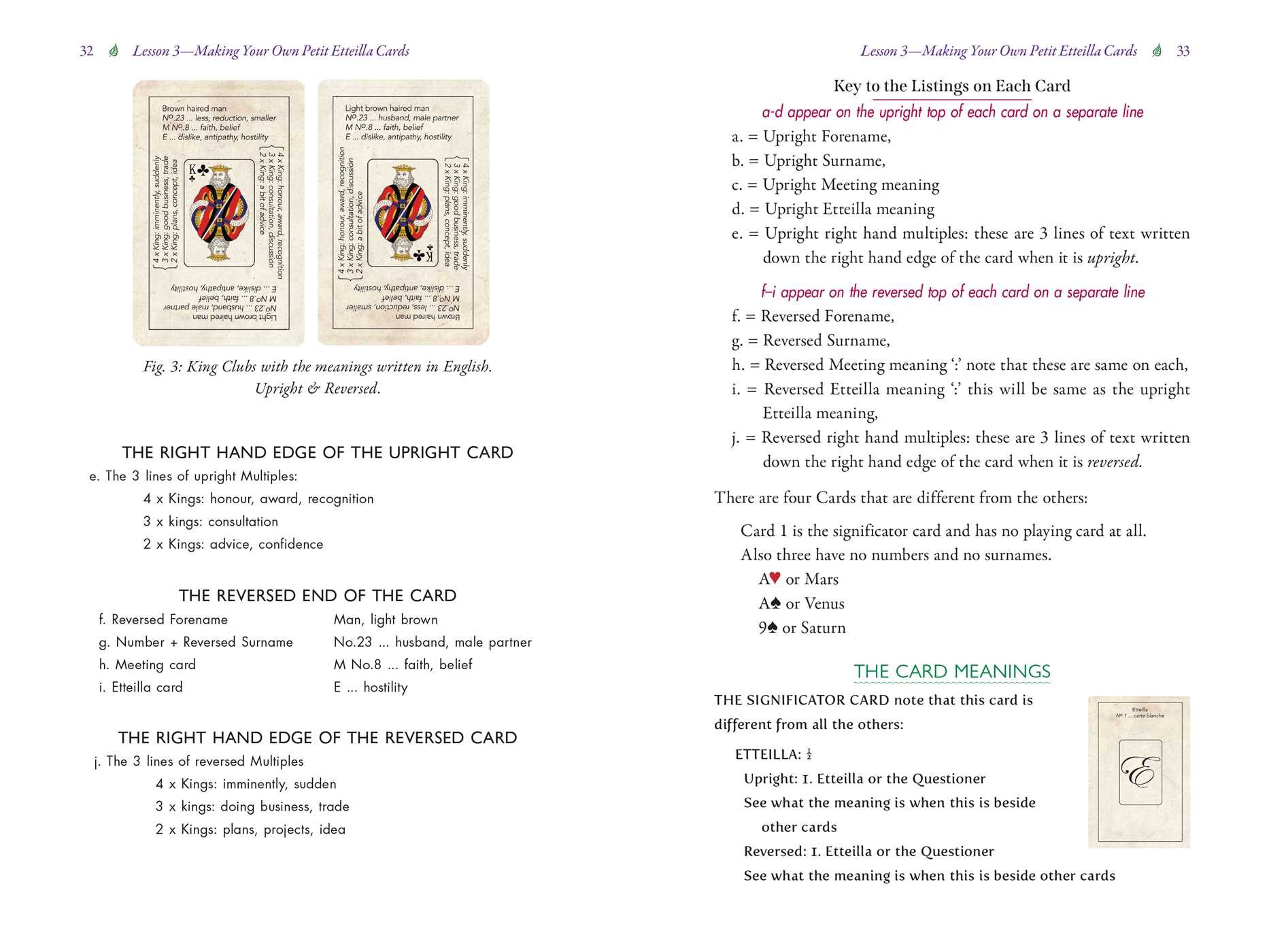
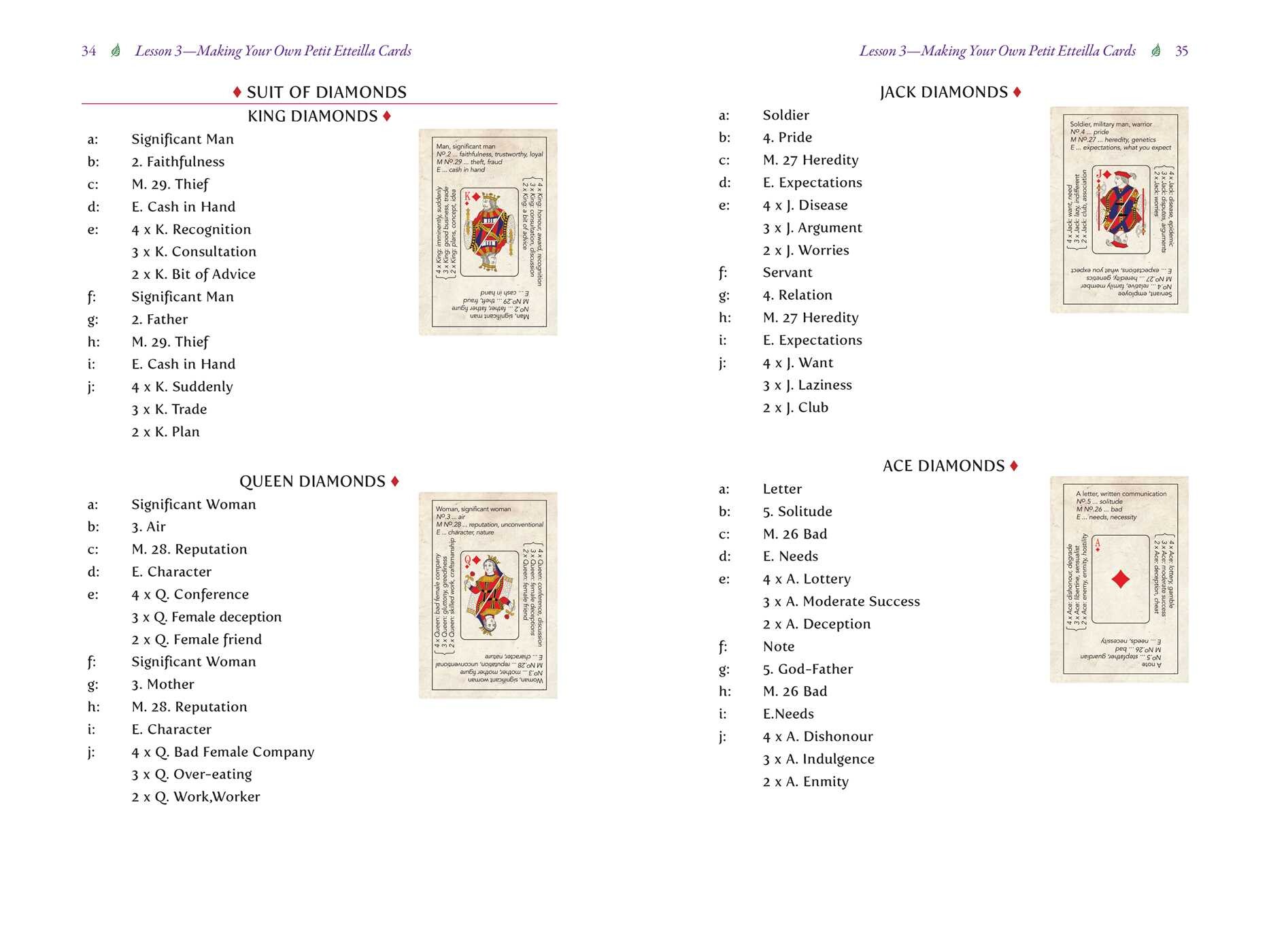
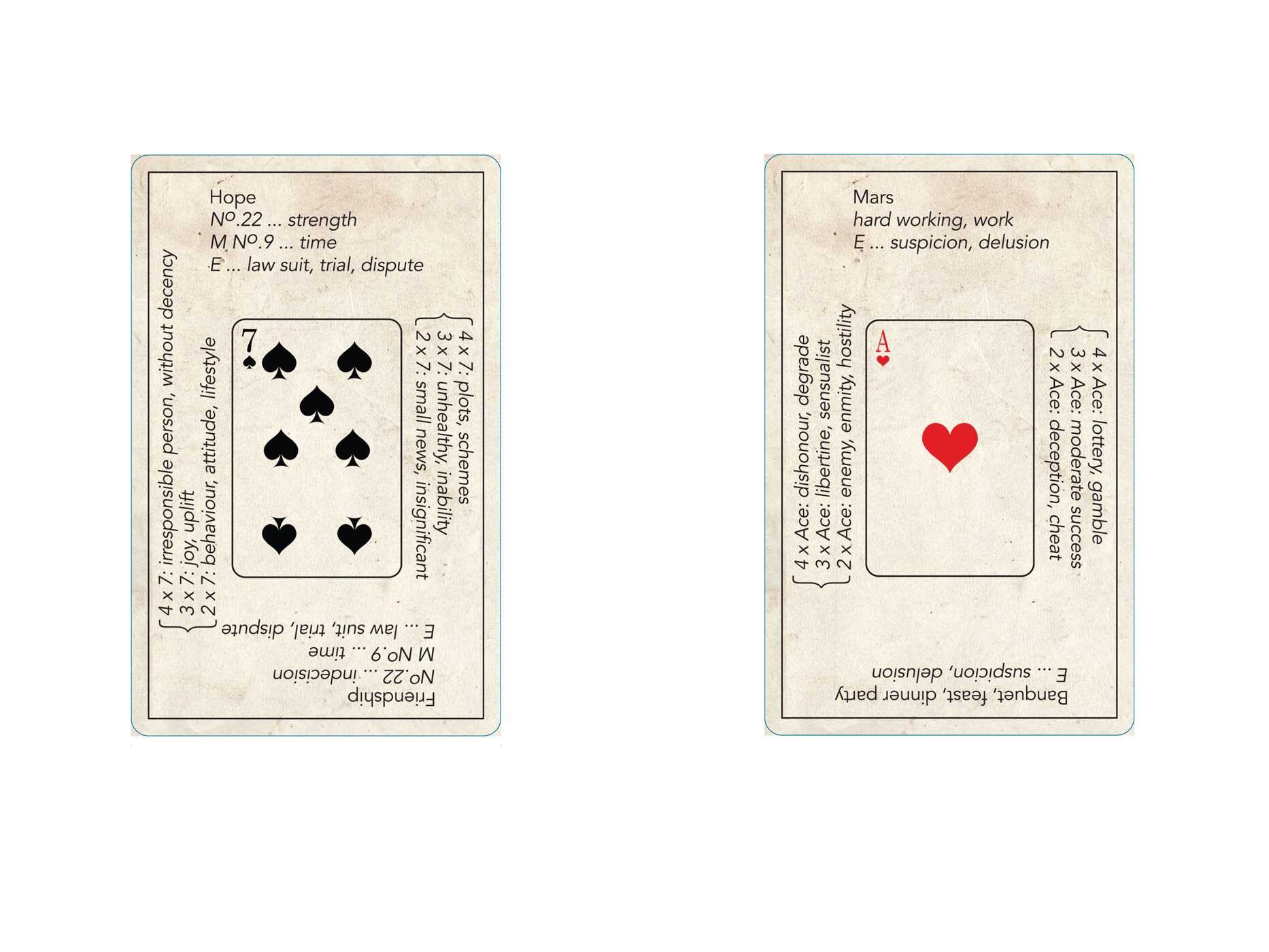
While learning the meanings of cards is a typical challenge of divination, in this course you can relax, as all of the meanings you will ever need are already written upon the cards, which you yourself will create. This will allow you to read and combine them without any need for memorization. By building up your reading from simple pairing and short line spreads, you will gain confidence and will soon be able to read Petit Etteilla for yourself and others.
WHO WAS ETTEILLA?
“Etteilla” was the pseudonym of Jean Baptiste Alliette (born March 1, 1738, in Paris, died December 13, 1791). If you want to say his name, then you pronounce it “Et-TIE-ya.” Active in the French esoteric scene, Etteilla chose his pseudonym by the simple process of reversing the one he already had! In these pre-Revolutionary days, and indeed right up until the present century, French authorities took a dim view of occultists and cartomancers in general and maintained draconian laws against public displays of divination or magic. For the purposes of taxation and the census, Etteilla was registered as a professeur d’algèbre, algebra professor, in order to avoid imprisonment. As he wrote himself, “whoever publicly reads as a cartomancer risks falling into the hands of the justices.”
The assertion that Etteilla was a hairdresser or wigmaker is entirely untrue: this has arisen from a connection to his son’s address, as he resided on the third floor of a house called Maison de Perruquier (house of the wigmaker) in the Palais Royal district. Born to parents in the seed trade, Etteilla worked as a print dealer in Paris and between 1777–1785 in Strasbourg, so he certainly had a knowledge of and contacts for printing cards. He remarks that Strasbourg was where the best tarot cards were made. So while Etteilla was a print dealer, he was never a hairdresser!
Etteilla’s pre-Revolutionary upbringing made him a humanist in the French Enlightenment manner, interested in esoteric matters and arcane writings but not much enamored of the predominantly Masonic influences of the evolving French esoteric scene. He began his cartomantic career by writing the first edition of his Petit Etteilla method—the very first cartomancy method in the world—in 1770: Etteilla, ou manière de se récréer avec un jeu de cartes, or A way to Recreate Yourself with a Pack of Cards. There is evidence that Etteilla had both problems with the government censor and with printers during its publication and that usurers were somehow involved. On page 32 of the 1773 edition, he writes about usury and usurers, “They will not buy my book, but they won’t prevent its publication!” suggesting that he had taken a loan in order to publish the book.
The Petit Etteilla method was created in a time when cards had not yet received an injection of metaphysical influence and so, although Etteilla writes about planetary cards and has a Horoscope Spread, he doesn’t give us any esoteric meanings—and we should not try to impose any either. Petit Etteilla is an entirely cartomantic system. His Book of Thoth Tarot (now the Grand Etteilla Tarot) is the place to look for esotericism, as Etteilla refocused his divinatory outlook in order to create an esoteric tarot of his own devising. He had been inspired by the essay on the tarot in Court de Gebelin’s 1781 book, Le Monde Primitif (The Primeval World) which (erroneously) presented a possible Egyptian origin for the tarot.*
So where did Etteilla learn his cartomancy? He said he learned it from “an old Piedmontese” called Alexis, whom he met at Lamballe in Brittany. Now Piedmont is the region of Italy that immediately borders France, so it is possible that the term “Piedmontese” could have been loosely used to mean “an Italian person,” or it could have been more specific. The question is, did Italy have a cartomantic tradition in the eighteenth century?
The major influence of an ongoing cartomantic tradition that had been active at least since 1725 might have been that of the Tarocchino Bolognese—a method of cartomancy using a reduced tarot deck of 62 cards. Evidence for divination with this pack was found in 1989 by Franco Pratesi in the University of Bologna library, where he found a list of meanings that equated individual tarot cards with divinatory keywords, for example, Star means “gift,” Queen Coins means “truth” (Decker 2002, 48–49). These same meanings are still in use today (Vitali 2005). Having made a study of Tarocchino Bolognese, I can assert that most of the meanings are not those followed by Etteilla, except in a few respects.
Tarot’s Batons are equivalent to the playing card Diamonds, while tarot’s Swords are Spades, from the Latin spatha, for “sword.” Tarot’s Cups are equivalent to playing card Hearts, and Coins are equivalent to Clubs, from the trefoils that emblazon many of the Coin cards. It seems clear that Etteilla created his own meanings and methods, as these differ from all other cartomantic methods.
Etteilla’s cartomancy was well under way in 1781 when the Swiss esotericist Antoine Court de Gébelin published his study Monde primitif, (The Primeval World). This and the writings of Gébelin’s disciple Comte de Mellet went on to have an immense influence upon Etteilla. In the eighth volume of this work, Gébelin claimed an Egyptian origin for the tarot—this was the original source of a long-held misassumption that still bedevils tarot to this day, since all tarot derives from fifteenth century Italy. Within two years of Monde primitif ’s publication, Etteilla had published his Manière de se récréer avec le jeu de cartes nommées Tarots, (A Way to Entertain Yourself with a Pack of Cards Called Tarots). He had in fact mentioned tarot as a method of divination in his two editions of the Petit Etteilla method, but there he called it “taraux,” as if he had never seen it written before but only heard it. It was from this time onward that tarot-reading acquired its esoteric focus, while it was from Etteilla’s Petit Etteilla that most of modern cartomancy derives.
In 1788 Etteilla founded a group called Société des Interprètes du Livre de Thot, or Society for the Interpreters of the Book of Thoth. This society may have been subscription-based, with the aim of raising enough money to print the tarot, which Etteilla had been unable to fund independently due to the expense of printing 78 cards. For this tarot, Etteilla rearranged his Petit Etteilla keywords into an entirely new pattern and, at the same time, changed his suit arrangements to follow the Comte de Mellet’s writings. They were finally printed and engraved to Etteilla’s designs; Eliphas Levi’s copy had a card (28, or 8 Batons) that included an advert for Etteilla’s location at 48 rue l’Oseille in Paris (Decker 2002, 90–91).
Welcome to The Original Petit Etteilla
Welcome to The Original Petit Etteilla. This is the first cartomancy course to provide the full translated text of Etteilla’s La Seule Manière de Tirer les Cartes, or The Only True Way to Draw the Cards, first published in 1773.
This course is for the cartomancy beginner who has always wanted to play Petit Etteilla. In The Original Petit Etteilla, I have striven to provide everything you will need to learn and work with the Petit Etteilla, drawing upon direct translation of Etteilla’s meanings and methods.
Even for a native French speaker, Etteilla’s book is not simple to understand. Eighteenth century French aside, by modern standards his methods are complex and long-winded. For this course I have both translated the complete text of his book and have provided clear explanations of his meanings, which are often given as just a single keyword online. The text is introduced over several lessons, so that you may come to understand the material’s application as well as its context. This is supplemented by examples of spreads and case histories to support you in learning the methods through daily practice.
Throughout his book, Etteilla demonstrates seven spreads, sequentially outlining the case of one woman for whom he reads. He invites you to lay out the cards for her, just as he has done, in order to learn his method. The original illustrations from his book are included so that you may follow along. This precise method of reading is very different from modern tarot reading, where the interpretation of a card’s image plays a much greater role. Etteilla is using a piquet or stripped deck of 32 playing cards, which includes only the 7, 8, 9, 10, Ace, Jack, Queen, and King of the 4 suits. By adding a Significator card, the modestly named Etteilla card (also refered to throughout the text as Carte Blanche, White Card), he makes a set of divination cards that have two sets of upright and reversed meanings.
While learning the meanings of cards is a typical challenge of divination, in this course you can relax, as all of the meanings you will ever need are already written upon the cards, which you yourself will create. This will allow you to read and combine them without any need for memorization. By building up your reading from simple pairing and short line spreads, you will gain confidence and will soon be able to read Petit Etteilla for yourself and others.
WHO WAS ETTEILLA?
“Etteilla” was the pseudonym of Jean Baptiste Alliette (born March 1, 1738, in Paris, died December 13, 1791). If you want to say his name, then you pronounce it “Et-TIE-ya.” Active in the French esoteric scene, Etteilla chose his pseudonym by the simple process of reversing the one he already had! In these pre-Revolutionary days, and indeed right up until the present century, French authorities took a dim view of occultists and cartomancers in general and maintained draconian laws against public displays of divination or magic. For the purposes of taxation and the census, Etteilla was registered as a professeur d’algèbre, algebra professor, in order to avoid imprisonment. As he wrote himself, “whoever publicly reads as a cartomancer risks falling into the hands of the justices.”
The assertion that Etteilla was a hairdresser or wigmaker is entirely untrue: this has arisen from a connection to his son’s address, as he resided on the third floor of a house called Maison de Perruquier (house of the wigmaker) in the Palais Royal district. Born to parents in the seed trade, Etteilla worked as a print dealer in Paris and between 1777–1785 in Strasbourg, so he certainly had a knowledge of and contacts for printing cards. He remarks that Strasbourg was where the best tarot cards were made. So while Etteilla was a print dealer, he was never a hairdresser!
Etteilla’s pre-Revolutionary upbringing made him a humanist in the French Enlightenment manner, interested in esoteric matters and arcane writings but not much enamored of the predominantly Masonic influences of the evolving French esoteric scene. He began his cartomantic career by writing the first edition of his Petit Etteilla method—the very first cartomancy method in the world—in 1770: Etteilla, ou manière de se récréer avec un jeu de cartes, or A way to Recreate Yourself with a Pack of Cards. There is evidence that Etteilla had both problems with the government censor and with printers during its publication and that usurers were somehow involved. On page 32 of the 1773 edition, he writes about usury and usurers, “They will not buy my book, but they won’t prevent its publication!” suggesting that he had taken a loan in order to publish the book.
The Petit Etteilla method was created in a time when cards had not yet received an injection of metaphysical influence and so, although Etteilla writes about planetary cards and has a Horoscope Spread, he doesn’t give us any esoteric meanings—and we should not try to impose any either. Petit Etteilla is an entirely cartomantic system. His Book of Thoth Tarot (now the Grand Etteilla Tarot) is the place to look for esotericism, as Etteilla refocused his divinatory outlook in order to create an esoteric tarot of his own devising. He had been inspired by the essay on the tarot in Court de Gebelin’s 1781 book, Le Monde Primitif (The Primeval World) which (erroneously) presented a possible Egyptian origin for the tarot.*
So where did Etteilla learn his cartomancy? He said he learned it from “an old Piedmontese” called Alexis, whom he met at Lamballe in Brittany. Now Piedmont is the region of Italy that immediately borders France, so it is possible that the term “Piedmontese” could have been loosely used to mean “an Italian person,” or it could have been more specific. The question is, did Italy have a cartomantic tradition in the eighteenth century?
The major influence of an ongoing cartomantic tradition that had been active at least since 1725 might have been that of the Tarocchino Bolognese—a method of cartomancy using a reduced tarot deck of 62 cards. Evidence for divination with this pack was found in 1989 by Franco Pratesi in the University of Bologna library, where he found a list of meanings that equated individual tarot cards with divinatory keywords, for example, Star means “gift,” Queen Coins means “truth” (Decker 2002, 48–49). These same meanings are still in use today (Vitali 2005). Having made a study of Tarocchino Bolognese, I can assert that most of the meanings are not those followed by Etteilla, except in a few respects.
Tarot’s Batons are equivalent to the playing card Diamonds, while tarot’s Swords are Spades, from the Latin spatha, for “sword.” Tarot’s Cups are equivalent to playing card Hearts, and Coins are equivalent to Clubs, from the trefoils that emblazon many of the Coin cards. It seems clear that Etteilla created his own meanings and methods, as these differ from all other cartomantic methods.
Etteilla’s cartomancy was well under way in 1781 when the Swiss esotericist Antoine Court de Gébelin published his study Monde primitif, (The Primeval World). This and the writings of Gébelin’s disciple Comte de Mellet went on to have an immense influence upon Etteilla. In the eighth volume of this work, Gébelin claimed an Egyptian origin for the tarot—this was the original source of a long-held misassumption that still bedevils tarot to this day, since all tarot derives from fifteenth century Italy. Within two years of Monde primitif ’s publication, Etteilla had published his Manière de se récréer avec le jeu de cartes nommées Tarots, (A Way to Entertain Yourself with a Pack of Cards Called Tarots). He had in fact mentioned tarot as a method of divination in his two editions of the Petit Etteilla method, but there he called it “taraux,” as if he had never seen it written before but only heard it. It was from this time onward that tarot-reading acquired its esoteric focus, while it was from Etteilla’s Petit Etteilla that most of modern cartomancy derives.
In 1788 Etteilla founded a group called Société des Interprètes du Livre de Thot, or Society for the Interpreters of the Book of Thoth. This society may have been subscription-based, with the aim of raising enough money to print the tarot, which Etteilla had been unable to fund independently due to the expense of printing 78 cards. For this tarot, Etteilla rearranged his Petit Etteilla keywords into an entirely new pattern and, at the same time, changed his suit arrangements to follow the Comte de Mellet’s writings. They were finally printed and engraved to Etteilla’s designs; Eliphas Levi’s copy had a card (28, or 8 Batons) that included an advert for Etteilla’s location at 48 rue l’Oseille in Paris (Decker 2002, 90–91).
Product Details
- Publisher: Destiny Books (February 26, 2026)
- Length: 352 pages
- ISBN13: 9798888503010
Browse Related Books
Raves and Reviews
“The Original Petit Etteilla is a wonderfully presented and approachable introduction to a historic card-reading system. The ‘Framing Your Question’ chapter is especially helpful, setting the tone for meaningful readings. The clear explanations and charming artwork make it easy to learn and a joy to use. I highly recommend this card deck to anyone looking to broaden their cartomancy practice.”
– Jen Sankey, author of Enchanted Forest Felines Tarot and Manifesting by the Moon
“A welcome, in-depth guide for both newcomers and those already focused on the process of understanding the meaning of reading the cards within the Etteilla system. The Original Petit Etteilla is a captivating read. A must-have for tarot enthusiasts, historians, and practitioners alike, this historical guide offers a beautifully written and detailed explanation of what can often be seen as a complex reading style.”
– Kim Arnold, founder of the UK Tarot Conference and author of Tarot Made Easy
“The Original Petit Etteilla is a deep dive into a cartomancy system that laid the groundwork for other methods, including my own beloved Lenormand. In this book, appropriately referred to as a ‘course’ by Caitlín Matthews, you will learn the history, lore, and methodology behind the Petit Etteilla created by occultist Jean Baptiste Alliette in the late 18th century. If you are curious about how playing cards can show us the story of our lives, this book is the place to start, and it pays homage to who and what started it all.”
– Erika Robinson, author of The Language of Lenormand
“The Original Petit Etteilla is an important link between older tarots and modern cartomancy. Caitlín and Rebecca have created a masterful guide, a rare gem that brings depth, clarity, and historical insights to this wonderful tarot. This guide is a wealth of wisdom, the only resource you need to understand this system.”
– Serge Pirotte, author of Mastering the Oracle Belline
“The Original Petit Etteilla casts fresh eyes on a delightful but long-ignored deck. The cards have been given a wonderful, clean, modern look without detracting from the original source, and the book is a thoroughly comprehensive storehouse of wisdom. Perfect for divination enthusiasts, both old and new alike.”
– Tara Sanchez, professional tarot reader and author of Urban Faery Magick
“In this accessible step-by-step guide, Caitlín Matthews intertwines her translation of Etteilla’s 1773 French text with her suggestions on using the Petit Etteilla method, making it relevant to the 21st-century diviner, with the lessons expanding Etteilla’s text and spreads. Elegantly designed by Rebecca Birrell, The Original Petit Etteilla is a must for any cartomancer looking to expand their divination skills.”
– Mascha Coetzee, cartomancer and deck reviewer at Musings by Mascha YouTube Channel
“Caitlín Matthews has skillfully prepared this translated version of the rare Petit Etteilla fortune-telling system, making it easy to understand and accessible for both seasoned readers and newcomers eager to explore cartomancy. Rebecca Birrell’s beautiful cards offer printed meanings for added support. Discover how to predict for yourself and others, and design your deck following Etteilla’s instructions!”
– Jozefa ‘Madame Seaqueen,’ owner of Ask My Cards Blog
“Lovely full-color designs by Rebecca Birrell and lively, engaging text by Caitlín Matthews. A veritable gift for fans of playing card history, designers, collectors, and readers, to name a few. I can dip in for a fun taste or dive deeper and easily engage with intricate Etteilla-style inspirations.”
– Mari Hoshizaki, creative and movement arts instructor
Resources and Downloads
High Resolution Images
-
Book Cover Image (jpg): The Original Petit Etteilla
Cards 9798888503010