Get our latest book recommendations, author news, competitions, offers, and other information right to your inbox.
Published by Inner Traditions
Distributed by Simon & Schuster
Table of Contents
About The Book
• Details an astrological system based on the 72 Qabalistic angels of the Sefer Raziel, the 72 Solomonic demons of the Ars Goetia, and the 72 quinaries of the zodiac
• Discusses the angels of the Shem HaMephorash and the Qabalistic lore surrounding them, the demons of the Ars Goetia and their origin in the Solomonic grimoire tradition, and how each demon is paired with its corresponding angel
• Explains the astrological meanings, significations, attributes, sigils, and seals of the 72 angels and their demon counterparts as well as how to apply these 72 quinarian keys of occult astrology to your own practice
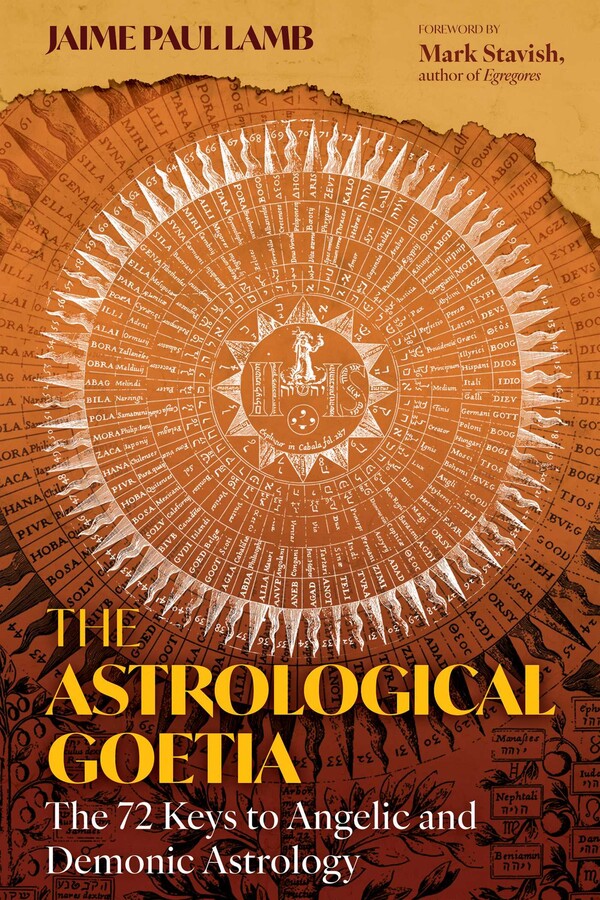
Blending zodiacal divination with Qabalistic magic and Solomonic demons, Jaime Paul Lamb details a system of occult astrology based on ancient texts. He discusses the angels of the Shem HaMephorash and the qabalistic lore surrounding them, the demons of the Ars Goetia and their origin in the Solomonic grimoire tradition, and how each demon is paired with a specific angel. He details the astrological meanings, significations, attributes, sigils, and seals of the 72 angels and their demon counterparts.
The author shows how the 72 Shem HaMephorash angels from the medieval Sefer Raziel HaMalakh and their corresponding 72 demons from the Ars Goetia (a Solomonic grimoire) are each associated with a specific 5-degree arc of the zodiac, with one angel-demon pair, or quinary, per segment. With 30 degrees in each astrological sign, there are thus 6 angel-demon quinaries for each sign, each providing new insights for understanding personality and fate. He examines the zodiac degrees ruled by each angel and demon and explains how the quinaries influence the planets within the 5 degrees that they rule.
Providing the historical, theoretical, and practical tools necessary to apply these 72 quinarian keys of occult astrology, Lamb’s guide allows astrologers to interpret individuals’ charts with greater subtlety and depth while simultaneously enhancing their own magical practice.
• Discusses the angels of the Shem HaMephorash and the Qabalistic lore surrounding them, the demons of the Ars Goetia and their origin in the Solomonic grimoire tradition, and how each demon is paired with its corresponding angel
• Explains the astrological meanings, significations, attributes, sigils, and seals of the 72 angels and their demon counterparts as well as how to apply these 72 quinarian keys of occult astrology to your own practice
Blending zodiacal divination with Qabalistic magic and Solomonic demons, Jaime Paul Lamb details a system of occult astrology based on ancient texts. He discusses the angels of the Shem HaMephorash and the qabalistic lore surrounding them, the demons of the Ars Goetia and their origin in the Solomonic grimoire tradition, and how each demon is paired with a specific angel. He details the astrological meanings, significations, attributes, sigils, and seals of the 72 angels and their demon counterparts.
The author shows how the 72 Shem HaMephorash angels from the medieval Sefer Raziel HaMalakh and their corresponding 72 demons from the Ars Goetia (a Solomonic grimoire) are each associated with a specific 5-degree arc of the zodiac, with one angel-demon pair, or quinary, per segment. With 30 degrees in each astrological sign, there are thus 6 angel-demon quinaries for each sign, each providing new insights for understanding personality and fate. He examines the zodiac degrees ruled by each angel and demon and explains how the quinaries influence the planets within the 5 degrees that they rule.
Providing the historical, theoretical, and practical tools necessary to apply these 72 quinarian keys of occult astrology, Lamb’s guide allows astrologers to interpret individuals’ charts with greater subtlety and depth while simultaneously enhancing their own magical practice.
Excerpt
INTRODUCTION
Illuminating the Quinaries
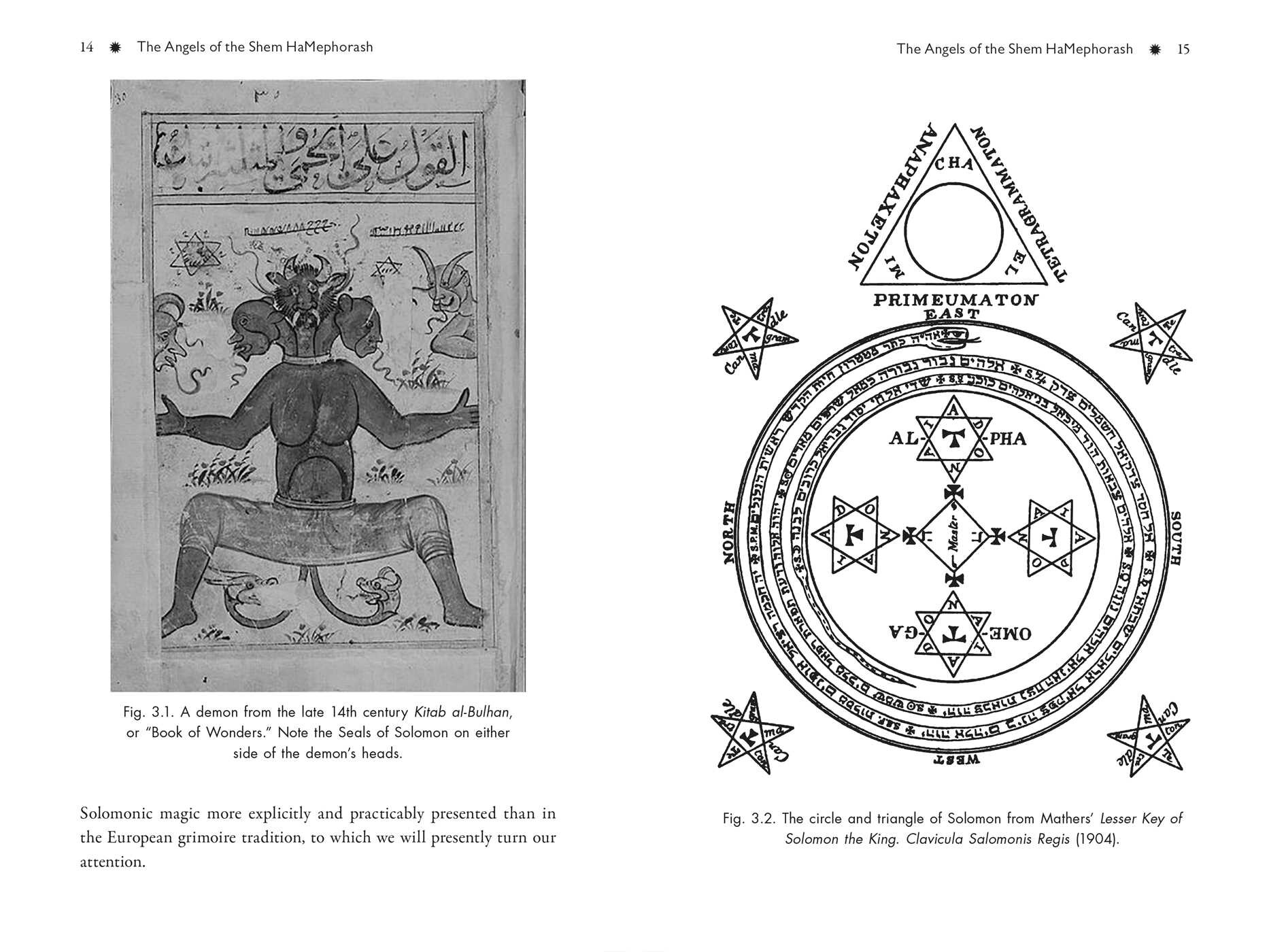
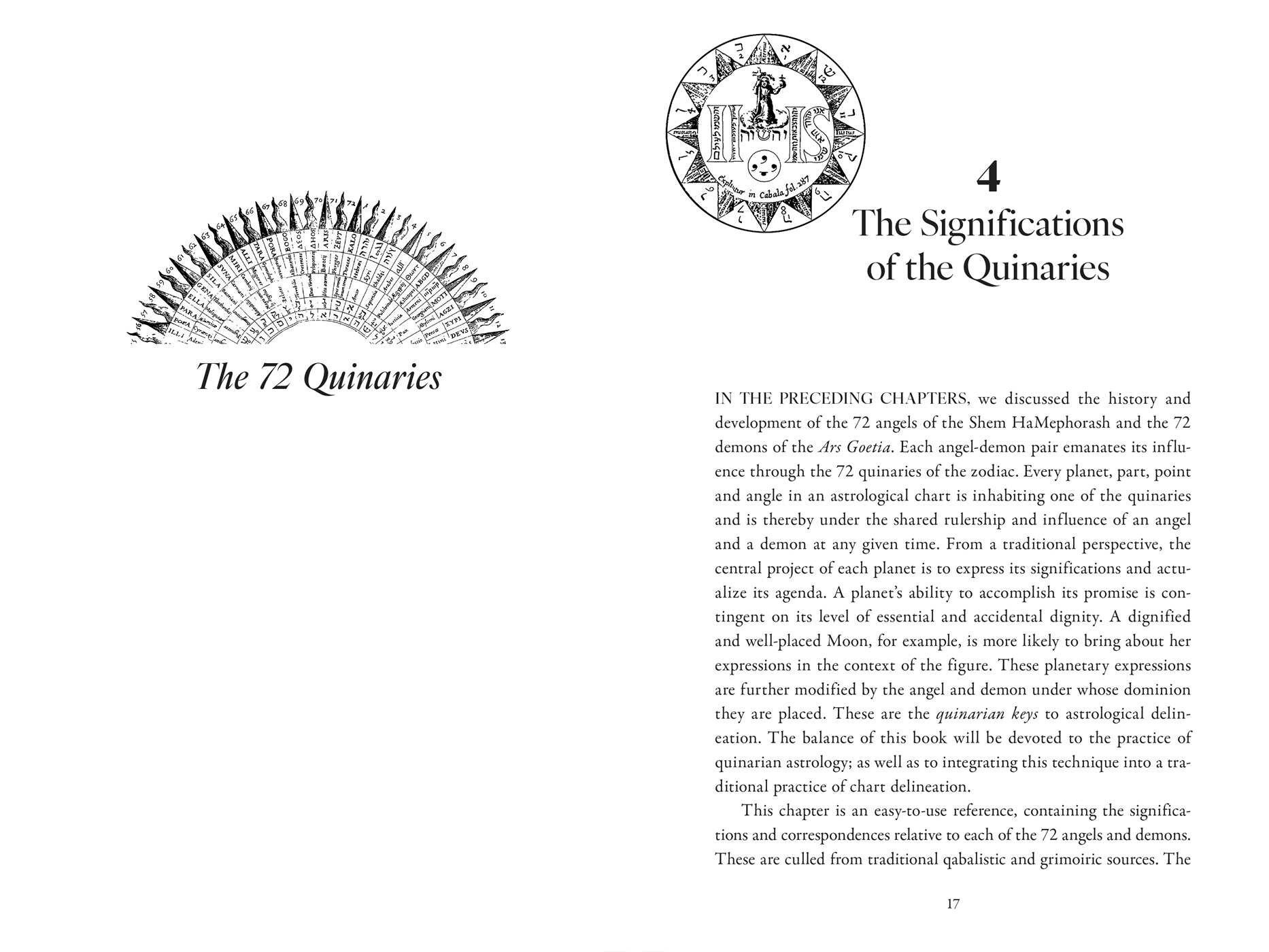
THE NAMES OF THE ANGELS of the Shem HaMephorash, which means “the Explicit Name” of God, are formed from three consecutive verses in the book of Exodus (14:19–21). There are 72 such angels, collectively having mystical significance in the Jewish esoteric tradition known as Qabalah. Similarly, 72 demons are described in an infamous grimoire on nigromancy (demonic magic) known as the Ars Goetia, which is the first of the five books comprising the Lesser Key of Solomon. Sometime during the early modern period, these angels and demons were organized into pairs, and each pair was assigned to a 5-degree arc segment of the zodiac called a quinary—one angel and one demon per quinary.1 The zodiac is divided into 72 such quinaries. The angels and demons rule and govern their respective quinaries, through which they emanate their astrological influence on the seven visible planets and from the planets to terrestrial life on Earth, or the sublunar world.2
According to the qabalistic and Solomonic grimoire traditions, each of the 72 angels of the Shem HaMephorash3 and the 72 demons of the Ars Goetia4 have a set of significations and attributes, as well as a scope of influence and activity unique to them. An array of topics such as memory, fertility, and divination, as well as activities such as finding hidden things, avoiding shipwrecks, and aiding in the study of the liberal arts, fall under the purview of the various angels and demons. And through the medium of the planets, their influence spans all aspects of terrestrial life.
In a traditional astrological figure (or chart), the seven visible planets are arrayed against the twelve 30-degree signs of the zodiac. The natural expression of each planet is modified by the quality of the zodiacal sign in which it is found. Consider a placement such as Mars in Pisces on the tenth house, for instance. The hot, dry, active energy of Mars is tempered by the cold, moist, passive mutability of Pisces, rendering the planet’s expression significantly altered in the context of the native’s career, symbolized by the tenth house. Similarly, each planet in an astrological figure resides in one of the quinaries and is therefore under the dominion of the angel and demon of that quinary. The angelic and demonic rulers of the quinaries bestow their influence upon any planet found within the cusps (borders) of their 5-degree segment of the zodiac.
For example, suppose a given chart shows Venus at 6 degrees Capricorn on the seventh house. This planet is in a quinary ruled by the angel Poiel and the demon Gremory because this pair has dominion over 5° 00'–9° 59' Capricorn. The astrologer will note that Venus’s natural significations—love, beauty, the arts, and so on—will be modified by the influence of Poiel and Gremory. Angelic Poiel “serves to obtain what one wants,”5 and demonic Gremory “procure[s] the Love of Women.”6 Clearly, there are positive, romantic auspices for our hypothetical native (the subject of a natal chart) in the context of the seventh house of romantic relationships. This is the essence of quinarian astrology.
This method may be applied to natal astrology, as in the example above, as well as to other astrological domains such as electional and horary. Electional astrology is used to decide the most auspicious time to set a cycle in motion. For instance, suppose you were planning a boating trip; you might choose to set sail at a time when the quinary ruled by the angel Ieiaiel was rising because Ieiaiel protects against storms and shipwrecks.7 That would be a favorable election, an auspicious moment to commence your voyage.
Horary astrology is used to answer specific questions. A chart is cast for the moment the question is understood by the astrologer. Suppose the querent asks, “Will I get the job at NASA?” A figure is erected, and the astrologer finds that the midheaven (symbolizing the querent’s profession, reputation, and status) is in the quinary of Morax, the goetic demon who rules over astronomy.8 Clearly, this would be a favorable factor in the overall horary delineation.
Despite having a body of clear and defined significations and a ready applicability to astrological analysis and chart delineation, the quinarian angels and demons have heretofore languished in the shadowy environs of the qabalistic and Solomonic grimoire traditions—underground and out of the reach of your typical astrologer. Having been cloistered away in the arcane world of Western occultism, they have never been incorporated into the mainstream astrological current. This book is an attempt to finally present quinarian astrology as a practicable system.
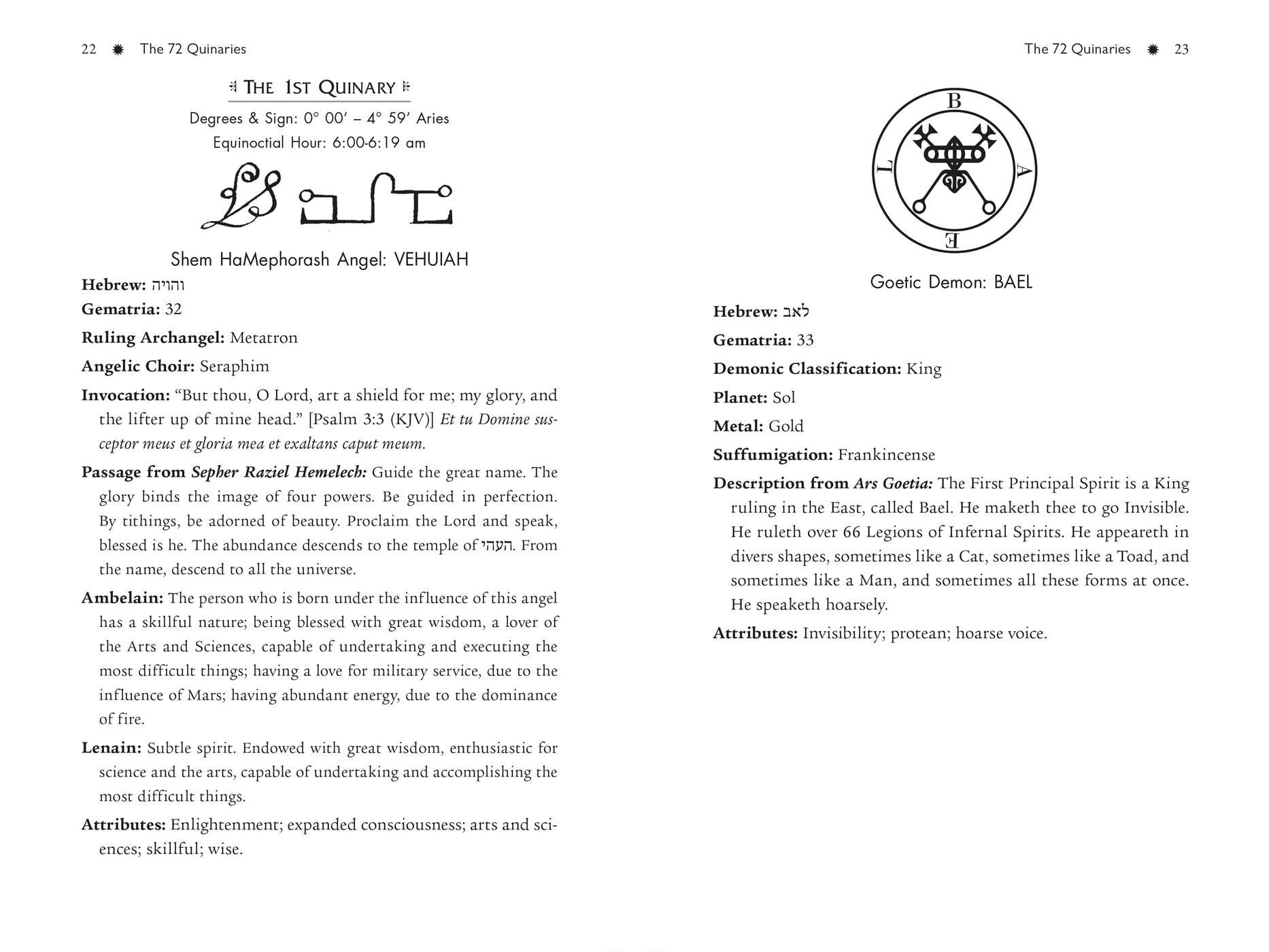
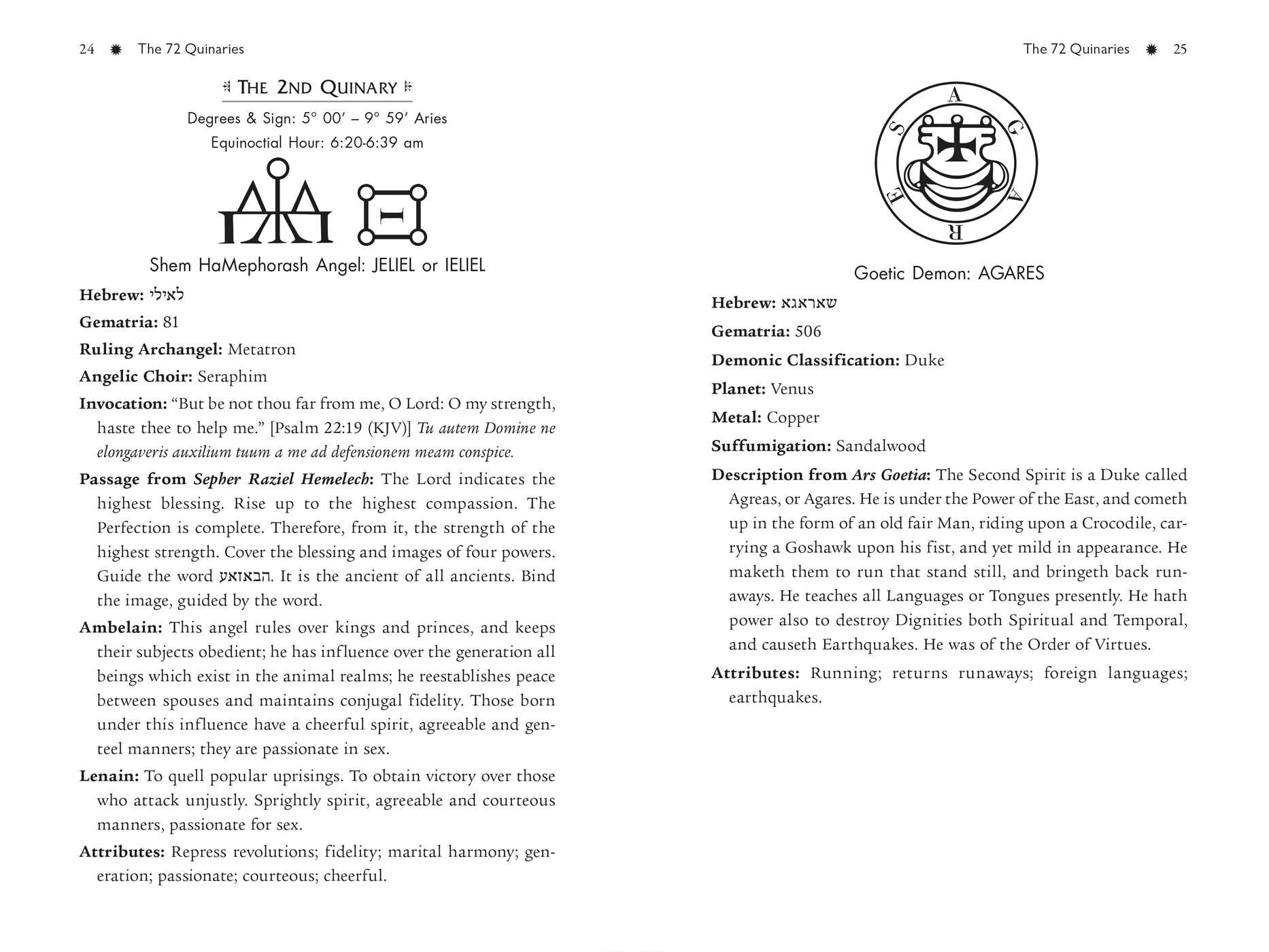
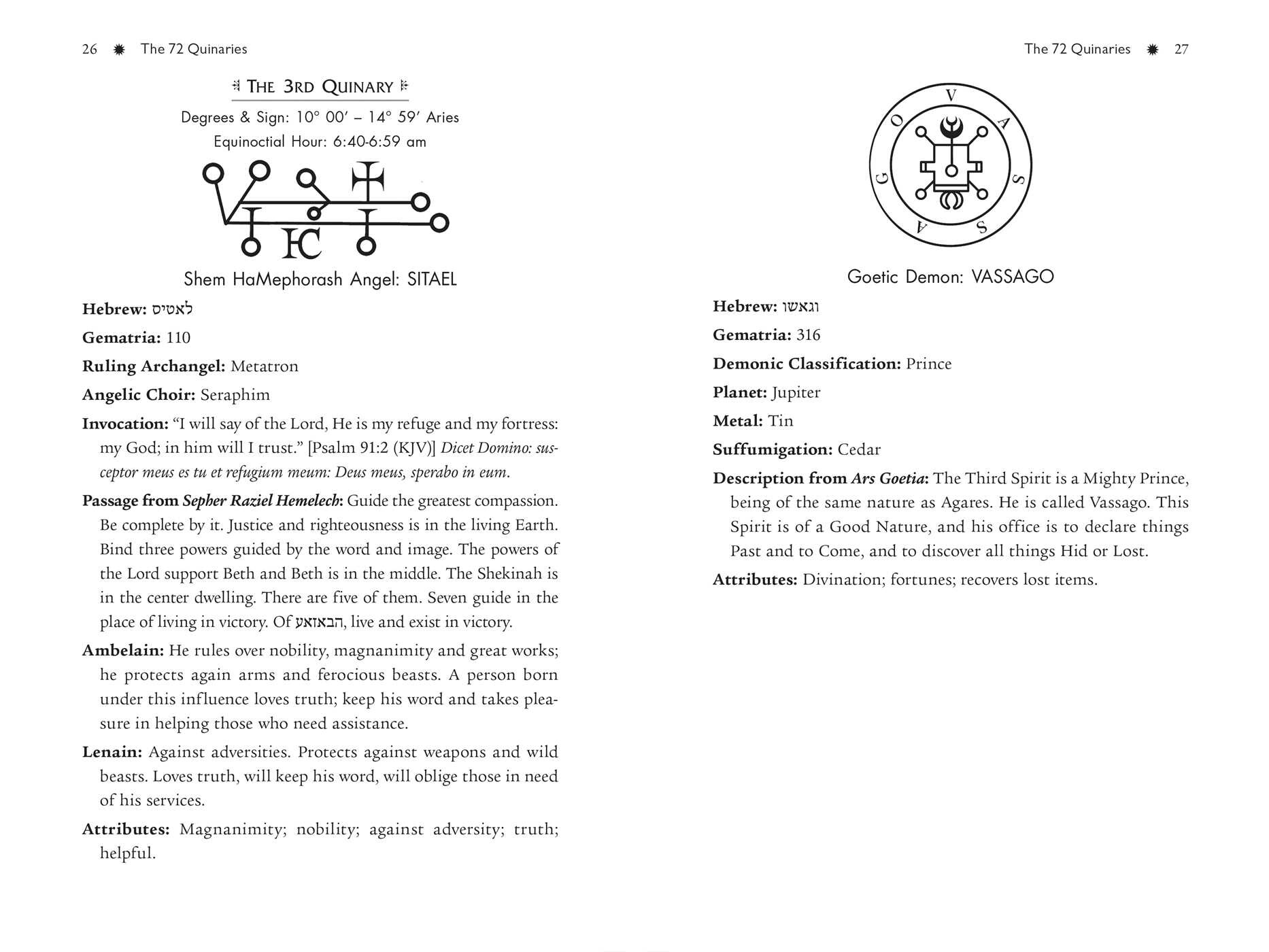
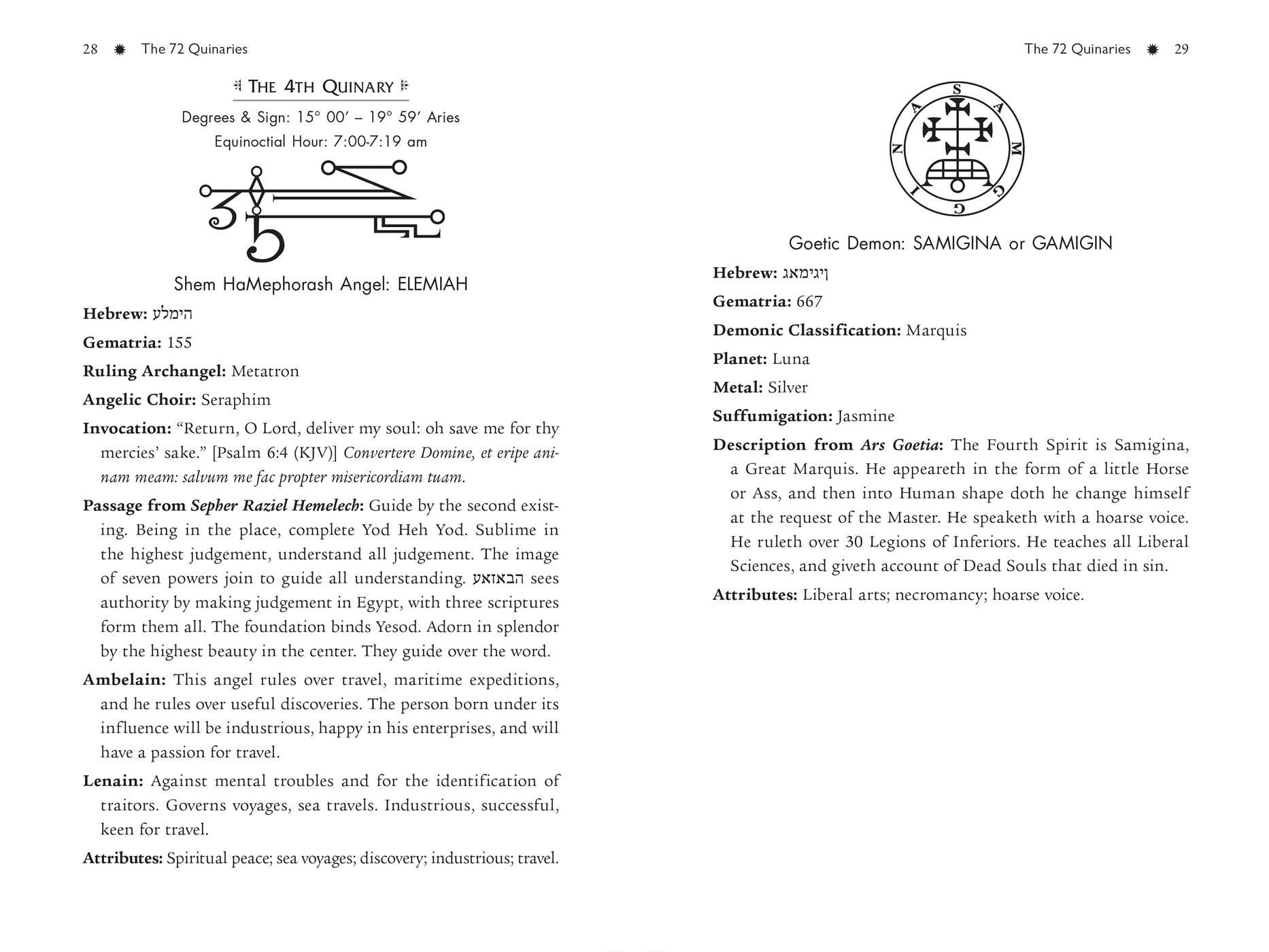
This book contains the names, attributes, sigils, and seals corresponding to each quinary, as well as the zodiacal degrees governed by each of the 72 angels and demons in an easy-to-reference, sequential arrangement. The quinarian pair governing each 5-degree segment of the zodiac is listed in order, beginning at 0 degrees 00 minutes Aries, all the way around the zodiac to 29 degrees 59 minutes Pisces—from the alpha to the omega of the ecliptic. The astrologer need only observe the zodiacal degree of the planet, part,* or angle under consideration, consult that quinary in the reference section of this book, then use the significations and attributes of the angel and demon to enhance their delineation of the placement.
Quinarian astrology is not some trendy new technique—its component parts have been embedded in the tradition for centuries. This book marks the first time the quinaries are being presented as a practicable delineation technique.9 The astrologer now has unprecedented *The part, also called Arabic part or lot, is a theoretical point, usually the distance between two planets, projected from the ascendant. access to the body of significations attributed to each of the angels and demons, enabling them to add further nuance to chart interpretation. The scheme of zodiacal rulership is also made clear—one need only know the degree and sign of a planet to determine its quinary, and then assign and assess angelic and demonic influence. In the two-thousand-plus-year history of horoscopic astrology, there have been very few innovations and only a handful of lost techniques that have been reconstructed.10 The component parts of this quinarian delineation technique are historically and philosophically grounded in the most esoteric corners of the Western astrological tradition, which is why they have managed to elude systemization—until now.
It should be remembered that all serious astrological analysis is multifactorial. The quinaries are not a substitute for the common methods of interpretation; they are supplemental to them. The delineation of planets configured in signs and houses is central to the art, but delineation is enhanced when extended techniques such as the quinarian approach are applied. The angelic and demonic dimension afforded by the quinaries simply sheds further light on the existing placements in a figure. When several techniques are wed in this manner, a fuller picture emerges from the puzzle of astrological symbolism; the astrologer’s hypotheses are accepted or rejected; and the true nature and character of the chart reveals itself. The depth and complexity of astrology is made clear in such a methodological synthesis.
This book is an attempt to bridge two worlds—the astrological and the magical—as these domains are mutually beneficial and, to some extent, activate each other. The qabalist, ceremonial magician, or Solomonic exorcist, approaching the subject with experience in their specialized corner of occultism, will see the underlying cosmic unity that only a developed sense of astrology can make possible. While most magicians working within the grimoire tradition will be familiar with elections, this book may inspire them to apply the angelic and demonic significations to natal and horary astrology. The modern astrologer, not typically conversant with the other Western esoteric traditions, will gain access to a new angelic and demonic dimension to their work, which they may then utilize in chart delineation, adding further detail and nuance to their art. This sort of exposure may even lead the intrepid astrologer into operative magical experimentation, such as the construction and consecration of talismans. For what is magic but the enchanted technology by which we accentuate the positive and mitigate the negative terrestrial effects of the stars and planets?
This book was written with the practitioner in mind. It is intended to aid in the practical synthesis of astrology and Western occultism by situating the 72 quinaries at the intersection of the two, in their rightful astrological context, and establishing them as a practicable technique. This is not to say that the quinarian lens should be the only one applied but, as most astrologers can affirm, when an astrologer gains similar results from applying several techniques, they are likely close to the truth. Using the quinaries as one of several metrics employed in judging charts has enriched my personal astrological practice.11 And, reciprocally, astrological proficiency has greatly enhanced my magical practice, particularly in terms of navigating astrological weather and engaging cosmic momentum in an operation. I feel confident that both the magician and the astrologer stand to gain by this peculiar quinarian synthesis of astrology and magic.
Illuminating the Quinaries
THE NAMES OF THE ANGELS of the Shem HaMephorash, which means “the Explicit Name” of God, are formed from three consecutive verses in the book of Exodus (14:19–21). There are 72 such angels, collectively having mystical significance in the Jewish esoteric tradition known as Qabalah. Similarly, 72 demons are described in an infamous grimoire on nigromancy (demonic magic) known as the Ars Goetia, which is the first of the five books comprising the Lesser Key of Solomon. Sometime during the early modern period, these angels and demons were organized into pairs, and each pair was assigned to a 5-degree arc segment of the zodiac called a quinary—one angel and one demon per quinary.1 The zodiac is divided into 72 such quinaries. The angels and demons rule and govern their respective quinaries, through which they emanate their astrological influence on the seven visible planets and from the planets to terrestrial life on Earth, or the sublunar world.2
According to the qabalistic and Solomonic grimoire traditions, each of the 72 angels of the Shem HaMephorash3 and the 72 demons of the Ars Goetia4 have a set of significations and attributes, as well as a scope of influence and activity unique to them. An array of topics such as memory, fertility, and divination, as well as activities such as finding hidden things, avoiding shipwrecks, and aiding in the study of the liberal arts, fall under the purview of the various angels and demons. And through the medium of the planets, their influence spans all aspects of terrestrial life.
In a traditional astrological figure (or chart), the seven visible planets are arrayed against the twelve 30-degree signs of the zodiac. The natural expression of each planet is modified by the quality of the zodiacal sign in which it is found. Consider a placement such as Mars in Pisces on the tenth house, for instance. The hot, dry, active energy of Mars is tempered by the cold, moist, passive mutability of Pisces, rendering the planet’s expression significantly altered in the context of the native’s career, symbolized by the tenth house. Similarly, each planet in an astrological figure resides in one of the quinaries and is therefore under the dominion of the angel and demon of that quinary. The angelic and demonic rulers of the quinaries bestow their influence upon any planet found within the cusps (borders) of their 5-degree segment of the zodiac.
For example, suppose a given chart shows Venus at 6 degrees Capricorn on the seventh house. This planet is in a quinary ruled by the angel Poiel and the demon Gremory because this pair has dominion over 5° 00'–9° 59' Capricorn. The astrologer will note that Venus’s natural significations—love, beauty, the arts, and so on—will be modified by the influence of Poiel and Gremory. Angelic Poiel “serves to obtain what one wants,”5 and demonic Gremory “procure[s] the Love of Women.”6 Clearly, there are positive, romantic auspices for our hypothetical native (the subject of a natal chart) in the context of the seventh house of romantic relationships. This is the essence of quinarian astrology.
This method may be applied to natal astrology, as in the example above, as well as to other astrological domains such as electional and horary. Electional astrology is used to decide the most auspicious time to set a cycle in motion. For instance, suppose you were planning a boating trip; you might choose to set sail at a time when the quinary ruled by the angel Ieiaiel was rising because Ieiaiel protects against storms and shipwrecks.7 That would be a favorable election, an auspicious moment to commence your voyage.
Horary astrology is used to answer specific questions. A chart is cast for the moment the question is understood by the astrologer. Suppose the querent asks, “Will I get the job at NASA?” A figure is erected, and the astrologer finds that the midheaven (symbolizing the querent’s profession, reputation, and status) is in the quinary of Morax, the goetic demon who rules over astronomy.8 Clearly, this would be a favorable factor in the overall horary delineation.
Despite having a body of clear and defined significations and a ready applicability to astrological analysis and chart delineation, the quinarian angels and demons have heretofore languished in the shadowy environs of the qabalistic and Solomonic grimoire traditions—underground and out of the reach of your typical astrologer. Having been cloistered away in the arcane world of Western occultism, they have never been incorporated into the mainstream astrological current. This book is an attempt to finally present quinarian astrology as a practicable system.
This book contains the names, attributes, sigils, and seals corresponding to each quinary, as well as the zodiacal degrees governed by each of the 72 angels and demons in an easy-to-reference, sequential arrangement. The quinarian pair governing each 5-degree segment of the zodiac is listed in order, beginning at 0 degrees 00 minutes Aries, all the way around the zodiac to 29 degrees 59 minutes Pisces—from the alpha to the omega of the ecliptic. The astrologer need only observe the zodiacal degree of the planet, part,* or angle under consideration, consult that quinary in the reference section of this book, then use the significations and attributes of the angel and demon to enhance their delineation of the placement.
Quinarian astrology is not some trendy new technique—its component parts have been embedded in the tradition for centuries. This book marks the first time the quinaries are being presented as a practicable delineation technique.9 The astrologer now has unprecedented *The part, also called Arabic part or lot, is a theoretical point, usually the distance between two planets, projected from the ascendant. access to the body of significations attributed to each of the angels and demons, enabling them to add further nuance to chart interpretation. The scheme of zodiacal rulership is also made clear—one need only know the degree and sign of a planet to determine its quinary, and then assign and assess angelic and demonic influence. In the two-thousand-plus-year history of horoscopic astrology, there have been very few innovations and only a handful of lost techniques that have been reconstructed.10 The component parts of this quinarian delineation technique are historically and philosophically grounded in the most esoteric corners of the Western astrological tradition, which is why they have managed to elude systemization—until now.
It should be remembered that all serious astrological analysis is multifactorial. The quinaries are not a substitute for the common methods of interpretation; they are supplemental to them. The delineation of planets configured in signs and houses is central to the art, but delineation is enhanced when extended techniques such as the quinarian approach are applied. The angelic and demonic dimension afforded by the quinaries simply sheds further light on the existing placements in a figure. When several techniques are wed in this manner, a fuller picture emerges from the puzzle of astrological symbolism; the astrologer’s hypotheses are accepted or rejected; and the true nature and character of the chart reveals itself. The depth and complexity of astrology is made clear in such a methodological synthesis.
This book is an attempt to bridge two worlds—the astrological and the magical—as these domains are mutually beneficial and, to some extent, activate each other. The qabalist, ceremonial magician, or Solomonic exorcist, approaching the subject with experience in their specialized corner of occultism, will see the underlying cosmic unity that only a developed sense of astrology can make possible. While most magicians working within the grimoire tradition will be familiar with elections, this book may inspire them to apply the angelic and demonic significations to natal and horary astrology. The modern astrologer, not typically conversant with the other Western esoteric traditions, will gain access to a new angelic and demonic dimension to their work, which they may then utilize in chart delineation, adding further detail and nuance to their art. This sort of exposure may even lead the intrepid astrologer into operative magical experimentation, such as the construction and consecration of talismans. For what is magic but the enchanted technology by which we accentuate the positive and mitigate the negative terrestrial effects of the stars and planets?
This book was written with the practitioner in mind. It is intended to aid in the practical synthesis of astrology and Western occultism by situating the 72 quinaries at the intersection of the two, in their rightful astrological context, and establishing them as a practicable technique. This is not to say that the quinarian lens should be the only one applied but, as most astrologers can affirm, when an astrologer gains similar results from applying several techniques, they are likely close to the truth. Using the quinaries as one of several metrics employed in judging charts has enriched my personal astrological practice.11 And, reciprocally, astrological proficiency has greatly enhanced my magical practice, particularly in terms of navigating astrological weather and engaging cosmic momentum in an operation. I feel confident that both the magician and the astrologer stand to gain by this peculiar quinarian synthesis of astrology and magic.
Product Details
- Publisher: Inner Traditions (September 23, 2025)
- Length: 272 pages
- ISBN13: 9798888501344
Browse Related Books
Raves and Reviews
“In a decade that has already seen an almost unprecedented resurgence of classical occult knowledge, Jaime Paul Lamb’s The Astrological Goetia marks a significant new contribution. Lamb has taken one of the neglected corners of magical lore—the symbolism and spirits of the 72 quinaries of the zodiac—and unfolded it into a fascinating and practical system that bridges the space between astrology and ceremonial magic.”
– John Michael Greer, author of The Twilight of Pluto
“By exploring the history of astrology from ancient Babylon, Egypt, and Greece to the medieval grimoire tradition, Jaime Paul Lamb makes the complex subject of astrology easier to understand and, for the skeptic, more plausible. The Astrological Goetia bridges the gap between astrology and magic, with Lamb illuminating the meaning of such material as angels and demons. Detailed historical descriptions of planetary angels and demons (and their influences) bring a new dimension to the subject and remind us of the depth of thought of our historical predecessors.”
– Angel Millar, author of Transcend the Chaos and The Path of the Warrior-Mystic
“This book breaks new ground with an illumined peek into ancient metaphysics to reveal the highly secretive mappings of the primordial lights of existence as scribed by the ancient Jewish sages in the form of the Shem HaMephorash. The Astrological Goetia is poised to be a valuable addition to the library of every seeker, offering insights into both the esoteric knowledge and practical aspects of occult astrology and angelic mysticism.”
– David Pantano, author of Alchemical Hermeticism
“A remarkably thorough and digestible look at the astrological wonders of the cascading fractals of consciousness known to kabbalists and magicians as the 72 angels of the Shem HaMephorash.”
– Lon Milo DuQuette, author of Understanding Aleister Crowley’s Thoth Tarot
“It is well known among occultists that since the appearance of the Testament of Solomon, the hordes of demons found in many grimoires are directly related to the thirty-six astrological decans and the twenty-eight mansions of the moon. But there is scant literature on the spirits behind the seventy-two quinaries of the zodiac. Following Rudd’s Liber Malorum Spirituum Seu Goetia Lemegeton Clavicula Salomonis, Lamb has done grimoirists and astrologers alike a great service by rendering the demons of the Lemegeton and the angels of the Shem HaMephorash in a practical, workable system that does not fail to emphasize their astrological underpinnings.”
– P. D. Newman, author of Theurgy
“The Astrological Goetia is a seminal work—the capstone of a complete astrological and magical corpus and some of Lamb’s sharpest writing to date. With this offering, the author provides not only the present but future generations of researchers and practitioners with a tremendous and invaluable resource. This is essential reading and a new classic of astrological magic.”
– Ike Baker, author of Ætheric Magic and host of Arcanvm Podcast
“A valuable addition to the library of an astrologer or student of the Hermetic sciences, bringing to life the connection between an astrological chart and the angels and demons of the Shem HaMephorash.”
– Chris Zalewski, author of Enochian Chess of the Golden Dawn
“Lamb’s work demands critical examination and holds the potential to unlock fascinating new avenues for astrologers and magicians alike.”
– Darcy Küntz, editor of The Hermetic Papers of the Golden Dawn
“This book will be especially appreciated by people who love books as objects of art; Inner Traditions has published the Astrological Goetia as a stylish hardcover, something to treat with the reverence that’s due. Astrological Goetia is...highly specialized and geared for the 'traditionalists' among occult practitioners.”
– Sara R. Diamond, FacingNorth.net
Resources and Downloads
High Resolution Images
-
Book Cover Image (jpg): The Astrological Goetia
eBook 9798888501344