Get our latest book recommendations, author news, competitions, offers, and other information right to your inbox.
Published by Inner Traditions
Distributed by Simon & Schuster
Table of Contents
About The Book
• Shares lessons on music and life purpose the author has received from nature since childhood, including through her work in wolf conservation
• Shows how connecting with nature can help you discover your true calling, release your hidden talents, and lead to spiritual growth
• Explores how music and the harmonies of nature offer powerful means for fostering communication between souls
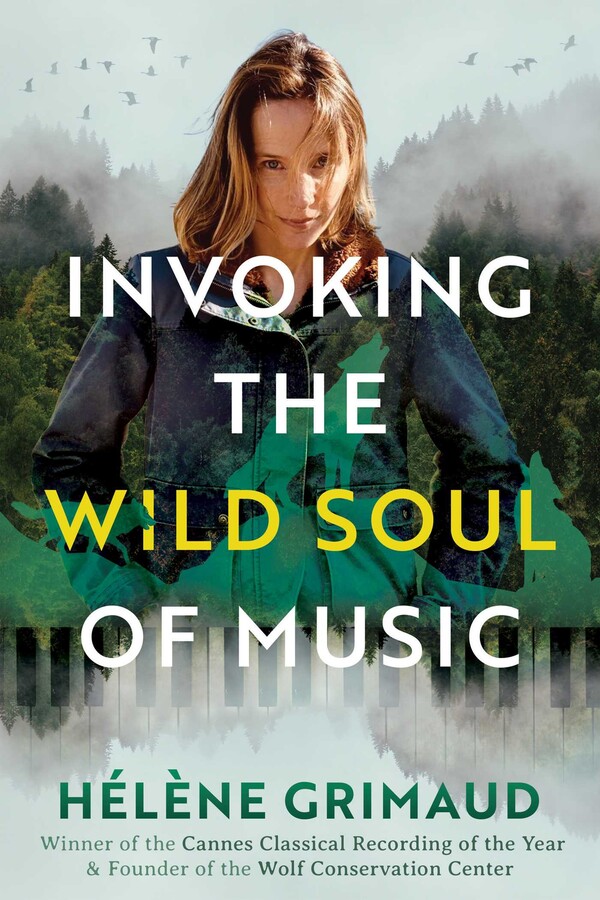
Internationally acclaimed piano virtuoso and founder of the Wolf Conservation Center, Hélène Grimaud shares her musical life’s journey and inspiring insights on the connections between music, nature, and spirituality.
In this book, Hélène offers the lessons she has learned about music and her life purpose from having direct contact with nature since childhood. She shares her concept of parent prodigies, such as her own, who can recognize the innate power and talents in their children and help guide them to self-realization, often by facilitating encounters with nature. And she shows that connecting with nature spirits can help reveal your true calling.
She reveals how her work protecting wolves teaches her about being human, and how it connects her to our hunter-gatherer ancestors. Hélène also explores how people create art to communicate the full spectrum of emotions. Self-knowledge and the understanding of any vocation is a vehicle for profound spiritual growth. From Lie Yukou’s True Classic of Perfect Emptiness and the compositions of Hildegard von Bingen, to the poetry of Novalis and Rimbaud, she details classics of spirituality, works of rebel poets, and the wisdom of shamans that serve as guides on her journey. These works and teachings reveal the connections between music and nature, including how music and the harmonies of nature offer powerful means for fostering the communication of souls.
Invoking the Wild Soul of Music reveals paths to rebirth, spiritual growth, and the re-enchantment of life. This memoir shows how to honor the call of the wild even in the heart of civilized modernity.
• Shows how connecting with nature can help you discover your true calling, release your hidden talents, and lead to spiritual growth
• Explores how music and the harmonies of nature offer powerful means for fostering communication between souls
Internationally acclaimed piano virtuoso and founder of the Wolf Conservation Center, Hélène Grimaud shares her musical life’s journey and inspiring insights on the connections between music, nature, and spirituality.
In this book, Hélène offers the lessons she has learned about music and her life purpose from having direct contact with nature since childhood. She shares her concept of parent prodigies, such as her own, who can recognize the innate power and talents in their children and help guide them to self-realization, often by facilitating encounters with nature. And she shows that connecting with nature spirits can help reveal your true calling.
She reveals how her work protecting wolves teaches her about being human, and how it connects her to our hunter-gatherer ancestors. Hélène also explores how people create art to communicate the full spectrum of emotions. Self-knowledge and the understanding of any vocation is a vehicle for profound spiritual growth. From Lie Yukou’s True Classic of Perfect Emptiness and the compositions of Hildegard von Bingen, to the poetry of Novalis and Rimbaud, she details classics of spirituality, works of rebel poets, and the wisdom of shamans that serve as guides on her journey. These works and teachings reveal the connections between music and nature, including how music and the harmonies of nature offer powerful means for fostering the communication of souls.
Invoking the Wild Soul of Music reveals paths to rebirth, spiritual growth, and the re-enchantment of life. This memoir shows how to honor the call of the wild even in the heart of civilized modernity.
Excerpt
1
THE OCEANIC SENSE OF LIFE
Helene Grimaud, you earned the praise of Andre Tubeuf, a friend of Elisabeth Schwarzkopf and Dietrich Fischer-Dieskau, a great musicographer in the tradition of Romain Rolland, and was, during his long life, a friend of the finest musicians from the creators of the operas of Richard Strauss to Rudolf Serkin. As a kind of lead in, with your permission, I would like to quote it. The portrait he painted of you makes an excellent starting point:
We didn’t think so highly of her at first, a clean-cut, vivacious, beau
tiful girl and not ashamed of it, a post-sixty-eight girl who was born
liberated and grew up free, we thought she was in a hurry because
she’s nimble, agile, and unencumbered. We thought she was a show-
off because photography suits her naturally, and she’s got fingers
that make the spectacular look easy, such as Rachmaninoff or the
superbly perilous Brahms. It took a long time for her to be accepted
as someone who takes her time, and is contemplative and silent. In
a dazzling polemic, written already a long time ago, Jean-François
Revel stated, against all establishments, doctors, specialists, that
a person will certainly not be a philosopher if he locks himself up
in philosophy, closing himself off to everything else. Grimaud has
opened things up. First the wide-open spaces. Thousands, perhaps
millions, rushed in, or thought they were rushing in, with her. And
then they bought one or two of her records. She opened something
else with her writing. Spaces that are wide open in a very different
way, landscapes with cypresses and cloisters. The castle of the soul.
Let’s set the scene and start by talking about your landscapes, your landscapes by birth and your landscapes by choice. How important are they to you?
If you’re going to paint a portrait, it’s a good idea to start with the frame. There are so many people who are unhappy with their stay on earth! So many people who feel like strangers even in the places they frequent every day and never leave, except when they go on vacation. So many people who feel suffocated in cities and others who feel suffocated by boredom in the countryside. For me, landscapes and their contemplation have always been essential to keep my balance. I would define myself as a citizen of the outside. I can be satisfied with the minimum comfort of a house. I’m not afraid of living in a somewhat spartan home, with only the most essential furnishings. Perhaps it’s because I’ve spent my life changing addresses, even countries, where sometimes I’m happy just to put down my bag without really moving in. I have to admit that between air travel and hotels, there’s nothing to encourage me to enjoy a sedentary lifestyle. But scenery, the natural scenery! I can’t go long without contemplating them or at least having their presence in my life. They are a vital need for me. First of all, it’s from an aesthetic point of view. Some of them are the most beautiful and harmonious compositions of creation. Then I’m filled with gratitude and wonderfully calm. They reassure me. They restore my balance. Especially after the chaos of touring. I’ve never traveled as much as when I sit in my successive houses in South Salem, Switzerland, or in California, when I, into contemplation of nature with the idea—early in the morning—that the sun needs my presence in order to rise, where at the precise moment of its appearance, I would catch a glimpse of the universal secret by surprise—the mystery of the world would then be revealed to me. I’ve always enjoyed this game, when I’m alone, of unwinding my memories of trees and horizons, as well as clouds, like opening an album of postcards, or else constructing a landscape in my imagination where I could then stroll in the golden light of memory. Citizen of the outside, but sedentary vagabond! Everywhere in the world there’s a little piece of Eden, as if Eden hadn’t vanished but had been divided up and hidden in an infinite number of places that we discover during the course of our wanderings or by the happenstance of our personal destiny.
You asked me how important landscapes have been to me. I would say that early on I began using them as mirrors. Just as we discover our faces by looking at them, I discovered myself by looking at landscapes. They soothed my difficulties in socializing with other children and how that worried my parents. In nature, I finally felt that I’d found my place both in the universe and in the way I felt “centered again” within myself—with a sense of newfound harmony.
When I was a child, my mother used to recite poetry to me, and I remember this line that she almost hummed when she caught me by surprise in the car with my face glued to the window lost in contemplation of the fields and hills: “Your soul is a chosen landscape.” For example, I have a precise memory of the moment when another specific landscape made me aware of my body and how it belongs to the earth. This was in Corsica, where I spent my vacations as a very young child with my parents. My mother was Corsican, a native of Olmo, a small mountain village. We would stay some hundred kilometers from there, not far from the sea, in Ghisonaccia to be exact. I used to sneak away on a path through the scrubland until the houses vanished from view. And I used to crouch down to avoid others seeing me and to give myself the illusion that I was alone in the world, closer to the ground, the ants, and the strongly aromatic wild plants. I used to then sniff the ground and listen with all my strength to the most imperceptible noises of nature. I was waiting, I didn’t know what for, to smell the unique fragrance of this countryside—a fragrance that comes back to me sometimes and causes this whole memory to surge up. I would also bury my nose in the V-neck of my T-shirt and breathe in the warm smell of my own body, which would make me dizzy and finally convince me of my own existence.
Yet you spent your childhood in a city, a city that is also musi-
cal, because it is the site of a world-famous festival. It’s where
Balthus, who admired you quite a bit, as he has told me several
times, worked on Don Giovanni in 1948 and on Cosi fan tutte in
1950. It’s as if Mozart’s music was already in the air before you
were born . . .
Yes, I’m a native of Aix-en-Provence. All the same, I’ve never been a city kid. I feel rather strongly that the city is the most contrary and alien environment for childhood possible. There, a child has no opportunity to literally melt into her surroundings, to lie down in the grass, for example, and discover and observe shapes, colors, life—a blade of grass and the chirping of a cricket. To touch and even squeeze all these strange things: a leaf, grass, flower petals, a dewdrop, and even a spider, as well as the dirt she kneads so she can smell its aroma. The bizarrely shaped insects that I wanted to taste as a very young child, much to my mother’s great displeasure. This experience is a little like a child’s discovery of music when touching the instruments and hearing the sounds they make.
I think our urban lifestyle is terrible. Unfortunately, we rarely have, if ever, the possibility to choose. They cut the child off from the discovery of the seasons. The succession of these four beats imparts an unforgettable rhythm to the soul. Like a teacher, nature teaches the child the connections between his or her own emotions and the profound meaning of the transformation of creation: the sadness of autumn, the withdrawal and introspection of winter, the hope and joy of spring, and fulfillment and abundance of summer. It also initiates us into the mystery of time and its very essence, which, in short, is our own. It teaches us of death, but that it is a necessary stage of resurrection. Last winter, I was overwhelmed by the appearance of a violet under some snow crystals that I had scooped up to rub on my face. The grass was already pushing toward the sky with that powerful green color that makes spring so vibrant.
THE OCEANIC SENSE OF LIFE
Helene Grimaud, you earned the praise of Andre Tubeuf, a friend of Elisabeth Schwarzkopf and Dietrich Fischer-Dieskau, a great musicographer in the tradition of Romain Rolland, and was, during his long life, a friend of the finest musicians from the creators of the operas of Richard Strauss to Rudolf Serkin. As a kind of lead in, with your permission, I would like to quote it. The portrait he painted of you makes an excellent starting point:
We didn’t think so highly of her at first, a clean-cut, vivacious, beau
tiful girl and not ashamed of it, a post-sixty-eight girl who was born
liberated and grew up free, we thought she was in a hurry because
she’s nimble, agile, and unencumbered. We thought she was a show-
off because photography suits her naturally, and she’s got fingers
that make the spectacular look easy, such as Rachmaninoff or the
superbly perilous Brahms. It took a long time for her to be accepted
as someone who takes her time, and is contemplative and silent. In
a dazzling polemic, written already a long time ago, Jean-François
Revel stated, against all establishments, doctors, specialists, that
a person will certainly not be a philosopher if he locks himself up
in philosophy, closing himself off to everything else. Grimaud has
opened things up. First the wide-open spaces. Thousands, perhaps
millions, rushed in, or thought they were rushing in, with her. And
then they bought one or two of her records. She opened something
else with her writing. Spaces that are wide open in a very different
way, landscapes with cypresses and cloisters. The castle of the soul.
Let’s set the scene and start by talking about your landscapes, your landscapes by birth and your landscapes by choice. How important are they to you?
If you’re going to paint a portrait, it’s a good idea to start with the frame. There are so many people who are unhappy with their stay on earth! So many people who feel like strangers even in the places they frequent every day and never leave, except when they go on vacation. So many people who feel suffocated in cities and others who feel suffocated by boredom in the countryside. For me, landscapes and their contemplation have always been essential to keep my balance. I would define myself as a citizen of the outside. I can be satisfied with the minimum comfort of a house. I’m not afraid of living in a somewhat spartan home, with only the most essential furnishings. Perhaps it’s because I’ve spent my life changing addresses, even countries, where sometimes I’m happy just to put down my bag without really moving in. I have to admit that between air travel and hotels, there’s nothing to encourage me to enjoy a sedentary lifestyle. But scenery, the natural scenery! I can’t go long without contemplating them or at least having their presence in my life. They are a vital need for me. First of all, it’s from an aesthetic point of view. Some of them are the most beautiful and harmonious compositions of creation. Then I’m filled with gratitude and wonderfully calm. They reassure me. They restore my balance. Especially after the chaos of touring. I’ve never traveled as much as when I sit in my successive houses in South Salem, Switzerland, or in California, when I, into contemplation of nature with the idea—early in the morning—that the sun needs my presence in order to rise, where at the precise moment of its appearance, I would catch a glimpse of the universal secret by surprise—the mystery of the world would then be revealed to me. I’ve always enjoyed this game, when I’m alone, of unwinding my memories of trees and horizons, as well as clouds, like opening an album of postcards, or else constructing a landscape in my imagination where I could then stroll in the golden light of memory. Citizen of the outside, but sedentary vagabond! Everywhere in the world there’s a little piece of Eden, as if Eden hadn’t vanished but had been divided up and hidden in an infinite number of places that we discover during the course of our wanderings or by the happenstance of our personal destiny.
You asked me how important landscapes have been to me. I would say that early on I began using them as mirrors. Just as we discover our faces by looking at them, I discovered myself by looking at landscapes. They soothed my difficulties in socializing with other children and how that worried my parents. In nature, I finally felt that I’d found my place both in the universe and in the way I felt “centered again” within myself—with a sense of newfound harmony.
When I was a child, my mother used to recite poetry to me, and I remember this line that she almost hummed when she caught me by surprise in the car with my face glued to the window lost in contemplation of the fields and hills: “Your soul is a chosen landscape.” For example, I have a precise memory of the moment when another specific landscape made me aware of my body and how it belongs to the earth. This was in Corsica, where I spent my vacations as a very young child with my parents. My mother was Corsican, a native of Olmo, a small mountain village. We would stay some hundred kilometers from there, not far from the sea, in Ghisonaccia to be exact. I used to sneak away on a path through the scrubland until the houses vanished from view. And I used to crouch down to avoid others seeing me and to give myself the illusion that I was alone in the world, closer to the ground, the ants, and the strongly aromatic wild plants. I used to then sniff the ground and listen with all my strength to the most imperceptible noises of nature. I was waiting, I didn’t know what for, to smell the unique fragrance of this countryside—a fragrance that comes back to me sometimes and causes this whole memory to surge up. I would also bury my nose in the V-neck of my T-shirt and breathe in the warm smell of my own body, which would make me dizzy and finally convince me of my own existence.
Yet you spent your childhood in a city, a city that is also musi-
cal, because it is the site of a world-famous festival. It’s where
Balthus, who admired you quite a bit, as he has told me several
times, worked on Don Giovanni in 1948 and on Cosi fan tutte in
1950. It’s as if Mozart’s music was already in the air before you
were born . . .
Yes, I’m a native of Aix-en-Provence. All the same, I’ve never been a city kid. I feel rather strongly that the city is the most contrary and alien environment for childhood possible. There, a child has no opportunity to literally melt into her surroundings, to lie down in the grass, for example, and discover and observe shapes, colors, life—a blade of grass and the chirping of a cricket. To touch and even squeeze all these strange things: a leaf, grass, flower petals, a dewdrop, and even a spider, as well as the dirt she kneads so she can smell its aroma. The bizarrely shaped insects that I wanted to taste as a very young child, much to my mother’s great displeasure. This experience is a little like a child’s discovery of music when touching the instruments and hearing the sounds they make.
I think our urban lifestyle is terrible. Unfortunately, we rarely have, if ever, the possibility to choose. They cut the child off from the discovery of the seasons. The succession of these four beats imparts an unforgettable rhythm to the soul. Like a teacher, nature teaches the child the connections between his or her own emotions and the profound meaning of the transformation of creation: the sadness of autumn, the withdrawal and introspection of winter, the hope and joy of spring, and fulfillment and abundance of summer. It also initiates us into the mystery of time and its very essence, which, in short, is our own. It teaches us of death, but that it is a necessary stage of resurrection. Last winter, I was overwhelmed by the appearance of a violet under some snow crystals that I had scooped up to rub on my face. The grass was already pushing toward the sky with that powerful green color that makes spring so vibrant.
Product Details
- Publisher: Inner Traditions (January 6, 2026)
- Length: 224 pages
- ISBN13: 9798888502167
Browse Related Books
Raves and Reviews
“Hélène Grimaud is a phenomenon! A world-renowned pianist, a gifted author, and an effective advocate of nature’s wilderness, she embodies what we all could aspire to—being our best selves. This book is incredibly inspiring, revealing, and intelligent.”
– THOMAS MOORE, psychotherapist, teacher, musician, and author of the New York Times bestseller Care o
“As a child, piano virtuoso Hélène Grimaud heard her first concerts in the sounds of Nature. It was here, in Nature, that music came alive and her life’s path was forged. Her memoir, Invoking the Wild Soul of Music, is a testament to the profound impact Nature can have on one’s life, starting with passion, leading to profession, and ultimately finding purpose.”
– PAM MONTGOMERY, author of Plant Spirit Healing and Co-Creating with Nature
Resources and Downloads
High Resolution Images
-
Book Cover Image (jpg): Invoking the Wild Soul of Music
eBook 9798888502167